Introduction — how the IELTS test works
Cambridge IELTS 19 Academic
Introduction
Read this before you start Test 1. It explains what the exam consists of, how it is marked, and how to read your own practice-test scores.
The test format
IELTS consists of four components. All candidates take the same Listening and Speaking tests. There is a choice of Reading and Writing tests according to whether a candidate is taking the Academic or General Training module. Everything in this book — and in these materials — is Academic.
The components are always taken in this order:
| Component | Shape | Time |
|---|---|---|
| Listening | 4 parts, 40 questions | about 30 minutes |
| Reading (Academic) | 3 sections, 40 questions | 60 minutes |
| Writing (Academic) | 2 tasks | 60 minutes |
| Speaking | 3 parts | 11 to 14 minutes |
Total test time: 2 hours 44 minutes.
Listening. Four parts of ten questions each. The first two are concerned with social needs — a conversation between two speakers, then a monologue. The last two are set in educational or training contexts — a conversation between up to four people, then a monologue.
Question types include multiple choice, matching, plan/map/diagram labelling, form completion, note completion, table completion, flowchart completion, summary completion, sentence completion and short-answer questions.
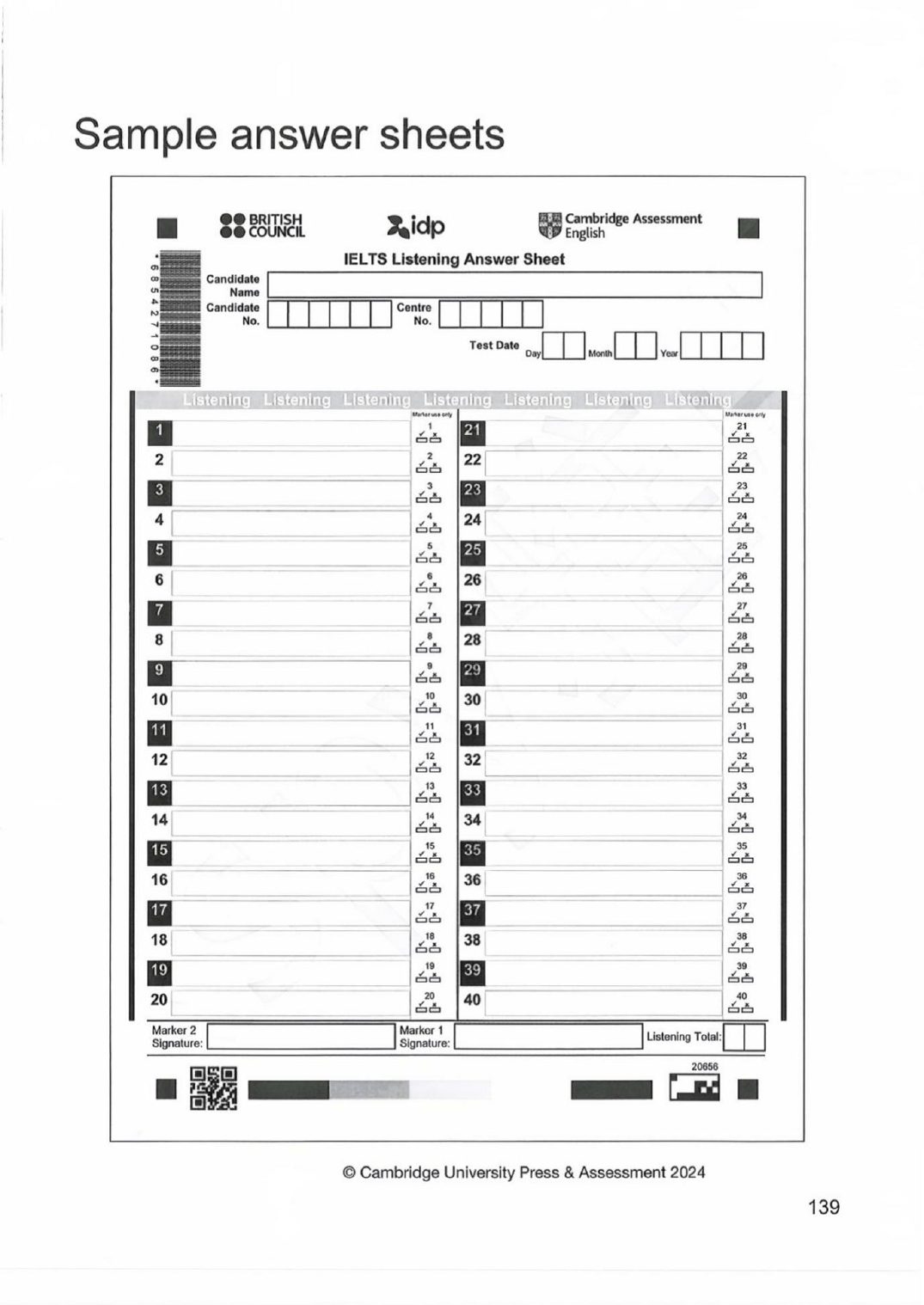
You hear the recording once only and answer as you listen. In the real exam, ten minutes are allowed at the end to transfer your answers to the answer sheet.
Reading. Three sections, 40 questions, three texts taken from journals, books, magazines and newspapers. At least one text contains detailed logical argument.
Question types include multiple choice, identifying information (True / False / Not Given), identifying the writer's views or claims (Yes / No / Not Given), matching information, matching headings, matching features, matching sentence endings, sentence completion, summary completion, note completion, table completion, flowchart completion, diagram-label completion and short-answer questions.
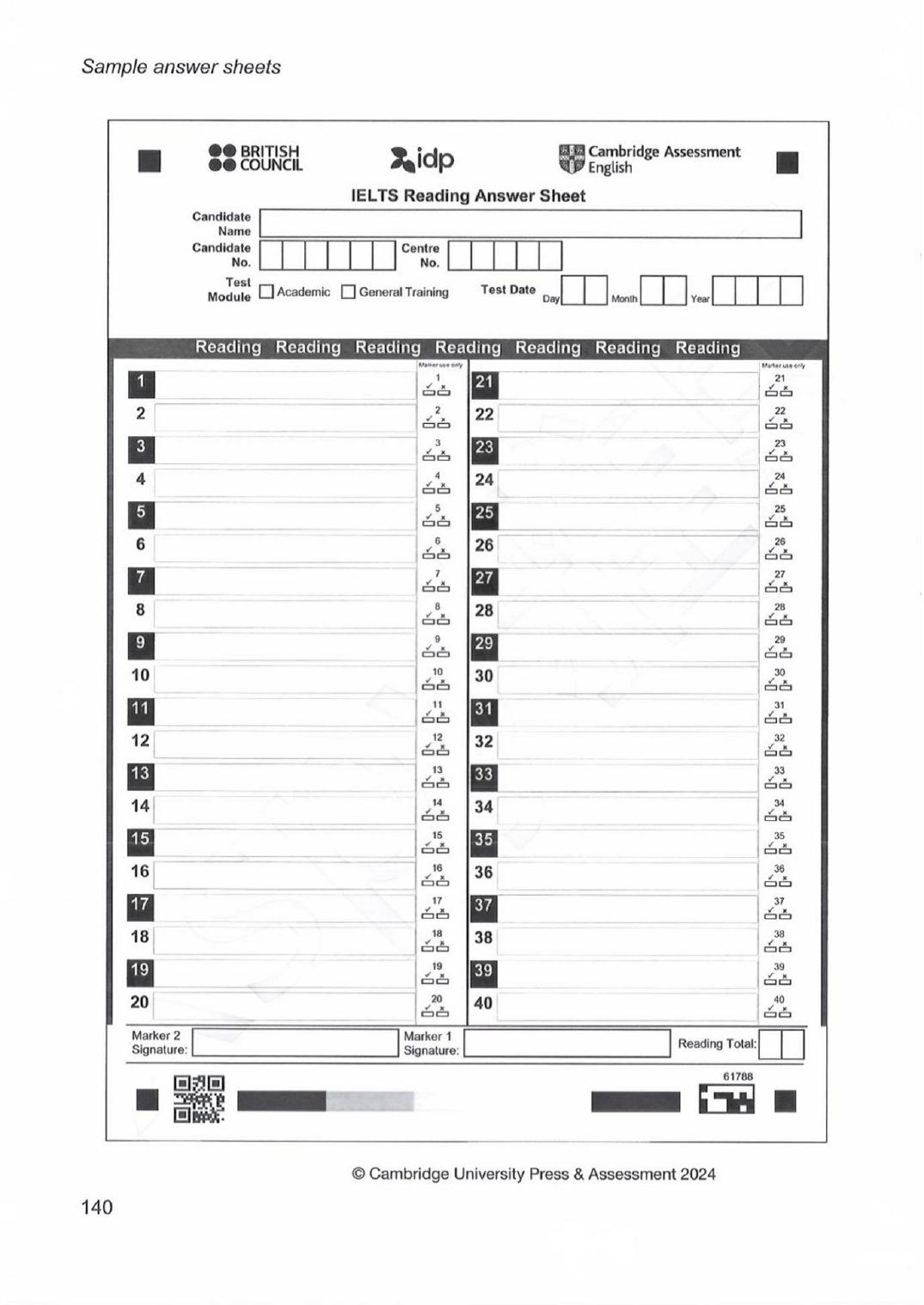
There is no extra time at the end of the Reading test to transfer answers.
Writing. Two tasks. Spend about 20 minutes on Task 1 (at least 150 words) and 40 minutes on Task 2 (at least 250 words). Task 2 contributes twice as much as Task 1 to the Writing score.
Task 1 asks you to look at a diagram or some data — a graph, table or chart — and present the information in your own words: organise it, compare it, describe the stages of a process, describe an object or event, or explain how something works.
Task 2 presents a point of view, an argument or a problem. You are assessed on presenting a solution, presenting and justifying an opinion, comparing and contrasting evidence and opinions, and evaluating and challenging ideas. You are also assessed on writing in an appropriate style.
Speaking. Eleven to fourteen minutes with a trained examiner, in three parts.
Part 1 — you and the examiner introduce yourselves; you answer general questions about yourself, your home and family, your work or studies, your interests and similar familiar topics. Four to five minutes.
Part 2 — you are given a task card with prompts and asked to talk on a particular topic. One minute to prepare and make notes, then one to two minutes of speaking, then one or two questions from the examiner on the same topic.
Part 3 — a discussion of more abstract issues thematically linked to Part 2. Four to five minutes.
The assessment takes into account Fluency and Coherence, Lexical Resource, Grammatical Range and Accuracy, and Pronunciation.
How IELTS is scored
Results are reported on a nine-band scale. You get an overall band score and a separate band for each of the four skills. Each band corresponds to a description of language ability:
| Band | ||
|---|---|---|
| 9 | Expert user | Has fully operational command of the language: appropriate, accurate and fluent with complete understanding. |
| 8 | Very good user | Fully operational command with only occasional unsystematic inaccuracies. Misunderstandings may occur in unfamiliar situations. Handles complex detailed argumentation well. |
| 7 | Good user | Operational command, though with occasional inaccuracies and misunderstandings in some situations. Generally handles complex language well. |
| 6 | Competent user | Generally effective command despite some inaccuracies and misunderstandings. Can use and understand fairly complex language, particularly in familiar situations. |
| 5 | Modest user | Partial command, coping with overall meaning in most situations, though likely to make many mistakes. Should be able to handle basic communication in own field. |
| 4 | Limited user | Basic competence limited to familiar situations. Frequent problems in understanding and expression. Not able to use complex language. |
| 3 | Extremely limited user | Conveys and understands only general meaning in very familiar situations. Frequent breakdowns in communication. |
| 2 | Intermittent user | Great difficulty understanding spoken and written English. |
| 1 | Non-user | Essentially no ability to use the language beyond possibly a few isolated words. |
| 0 | Did not attempt the test | Did not answer the questions. |
Marking your own practice tests
Listening and Reading. Every question is worth one mark, so each test is scored out of 40. On this platform the answers are checked for you and every question carries an explanation.
A few rules that the real exam applies, and that are worth practising here:
Answers may be written in upper or lower case. Words in brackets are optional. Alternative answers are separated by a slash. All answers require correct spelling — both US and UK spellings are accepted.
If a question asks for an answer in a certain number of words or numbers, you are penalised for exceeding it: if the instruction says NO MORE THAN THREE WORDS and the answer is 'black leather coat', then 'coat of black leather' is wrong. Where you complete a gap, write only the missing words: to complete 'in the . . .' where the answer is 'morning', writing 'in the morning' is wrong.
For letter answers, write only as many letters as are asked for. More letters than required means the answer is marked wrong.
Writing. You cannot give yourself a mark for the Writing tasks. Instead, each Writing material here includes a sample answer written by a real candidate, with the band it was awarded and the examiner's comment. Write your own answer first, then open the sample and compare.
Speaking. Judged by a person, not by a score sheet. Record yourself, listen back, and bring the recording to your teacher.
How to read your Listening and Reading score
At the end of each Listening and Reading test in the book there is a chart to help you judge whether you are ready to take the real exam. You do not need to look it up here: when you finish a test, the platform shows your score out of 40 together with Cambridge's own verdict for that test. The ranges differ from test to test, so the panel always uses the ones printed for the test you have just done.
That score counts your first attempt — what you had right before any explanation appeared. Keep two things in mind. Your performance in the real test may differ from your practice-test results, and a raw score does not convert to a band score by a fixed formula: the conversion varies slightly with each version of the test.
A note about the counter on this platform. A Listening material shows 44 items rather than 40: the four extra are the recordings themselves, which count as 'listened to'. That counter tracks progress; the score counts the 40 questions only.
Результат вы увидите в конце каждого теста: балл из 40 и кембриджский вердикт с границами именно для этого теста, по ответам с первой попытки. В счётчике Listening 44 — сорок вопросов плюс четыре аудио; в балл идут только вопросы.
The answer sheets
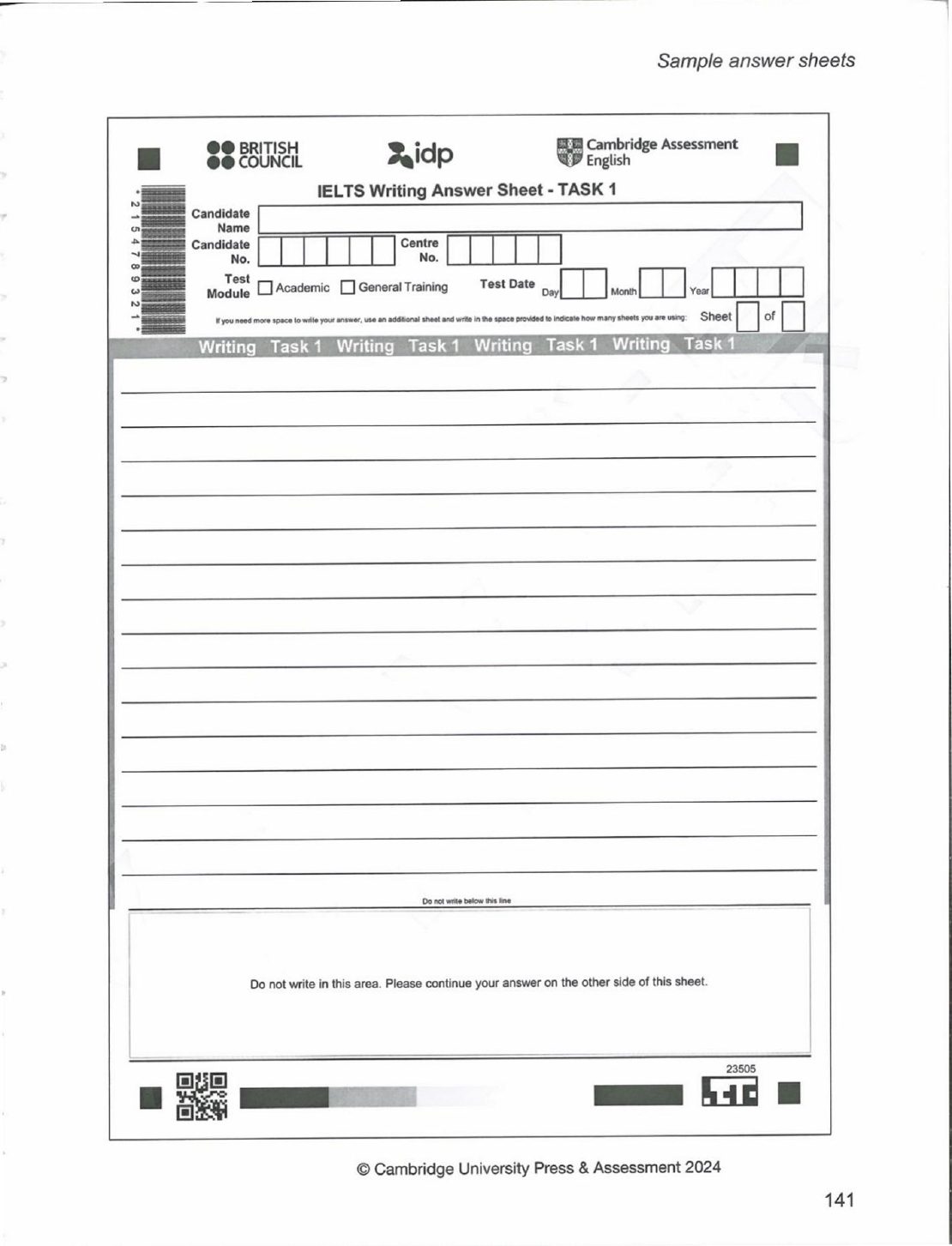
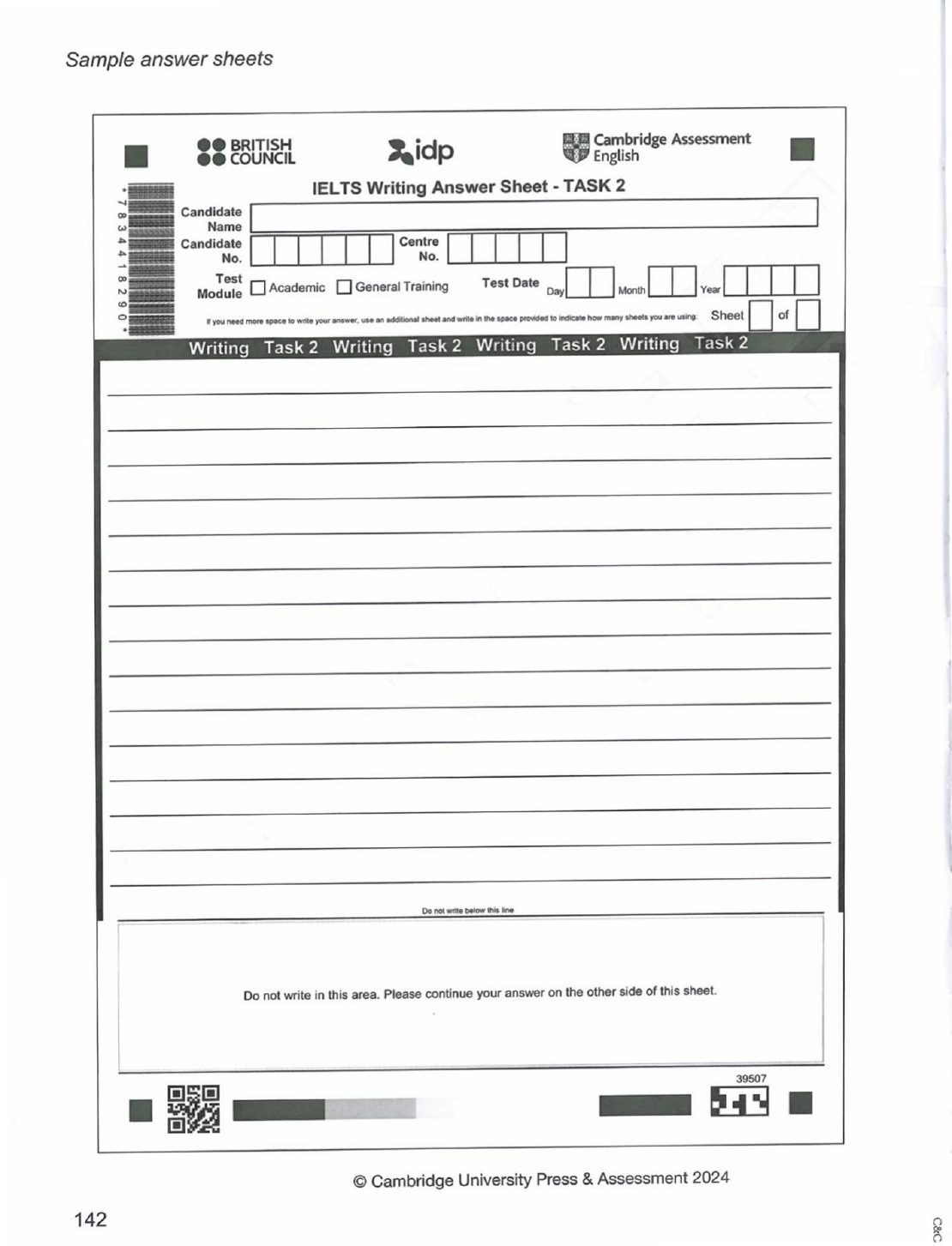
In the real exam you write your answers on these sheets. Look at them before your first test — knowing the layout saves time on the day.
Listening
Reading
Writing — Task 1
Writing — Task 2
IELTS is jointly managed by the British Council, IDP: IELTS Australia and Cambridge University Press & Assessment. Further information is at ielts.org.