extr@ English — Episode 1: Hector's Arrival
extr@ English
Episode 1 · Hector's Arrival · A2 video lesson
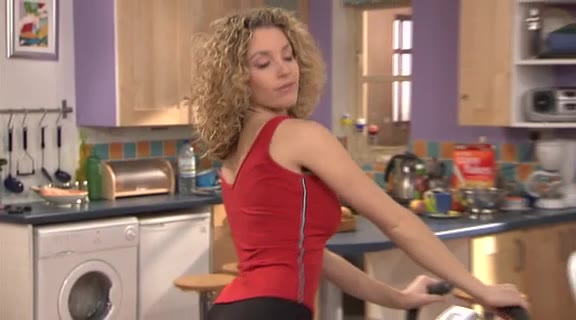
This is the story of Bridget and Annie, who share a flat in London. They have a neighbour, Nick. Nick fancies Bridget. But Annie fancies Nick. That's the way it is — until Bridget gets a letter from Argentina.
How to work with this lesson. The episode is in three parts. Before each part, read the exercises — then watch, then answer. Watch without subtitles the first time; the CC button is there for a second viewing.
Meet the characters
Match the photos with the descriptions.


Read the information about the characters and then complete the sentences.
Bridget and Annie live together in a flat in London. Bridget is pretty and likes exercising. Annie is friendly and relaxed. She has a dog. Nick is a neighbour of Bridget and Annie, and he spends a lot of time in their flat. Hector is from Argentina. Seven years ago, he was Bridget's pen pal. Now he's in London but he doesn't speak English very well. Hector is quite rich. At home in Argentina, he has a lot of fast cars and there are several servants in his house.
1. Bridget and Annie .
2. Hector and Bridget .
3. Nick and Hector .
Check the meaning
Complete the sentences with the correct word.
1. People who say Please and Thank you are very .
2. It was very of you to tell the police officer that he was ugly!
3. That pop star looks VERY in that dress.
4. He's enough to stay in the most expensive hotels.
5. My sister told us a really story about a monkey at the zoo.
6. That man in the street with the dark glasses looks a bit .
7. It was very of you to buy me some flowers.
Wordwatch — fancy
The word fancy appears regularly in extr@. It means find someone attractive: I fancy him. / Do you fancy her? It is very common among young British speakers — but don't ask an English speaker Do you fancy me? directly!
Before you watch, look at the photos and answer the questions.

How does Bridget feel about Nick watching her ride her exercise bike?

What do the girls think when they see Hector come out of the bathroom?
Watch Part one
A. Choose the correct word or phrase to complete these sentences.
Example: Bridget gets a letter from Argentina. (email / letter / postcard / parcel)
1. Hector wants towith Bridget and Annie.
2. He is going to arrive.
3. Bridget has anin the flat.
4. Bridget gets verywith Nick when he uses it.
5. When Hector arrives at the door, he's wearing.
B. Complete the answers to these questions.
Who's Hector? — He was my pen pal …
When is he coming? — He's coming on the …
Would you like a drink, Nick?
C. After watching Part one, do we know these things? True = yes, we know. False = no, we don't.
We know where Hector comes from.
We know Bridget's job.
We know who Nick fancies.
We know the name of the dog.
We know the nickname of the landlady.
Extra practice
Watch the girls read Hector's letter one more time, then do A and B.
A. Hector's English is not perfect yet. Tap the two words he gets wrong.
Tap the two mistakes.
B. Now write Hector's letter correctly.
1. Seven years ago we penpals.
2. I speak English now.
3. I am called .
4. I am from .
C. Who says these lines?
"Nobody uses my bike. Nobody. Is that clear?" —
"I forget nothing!" —
"Ooh, a Latin American here. Ooh, like Ricky Martin!" —
"I am called Argentina. I am from Hector." —
D. Put these events in the order they happen in Part one.
- The girls read the letter from Argentina.
- Hector knocks at the door.
- Nick brings back the milk he borrowed three weeks ago.
- Bridget opens a parcel from her mother.
- Charley brings the post and Annie takes it.
- John phones Bridget and she says goodbye to him.
- Nick gets on Bridget's exercise bike.
E. Put the words in the right order.
- Nick
- a
- like
- drink
- would
- ,
- you
- ?
- Uses
- my
- nobody
- bike
- .
- What
- say
- does
- it
- ?
F. Tap the pairs.
G. Listen and write down what you hear.
H. Tap what you hear. Use the Slow button if you need it.
Useful lines from Part one
- Who's Hector? — He was my penpal seven years ago.
- When is he coming? — He's coming on the fifth of November.
- Would you like a drink? — No, thanks.
- Nobody uses my bike. Is that clear?
Watch Part two
A. Put these events in the correct order.
- Hector shows his photographs to Bridget and Annie.
- The girls leave and Nick gives Hector an English lesson.
- Hector meets Nick and thinks he's a butler.
- Bridget and Annie show Hector the bedroom.
- Annie writes an email to her friend Nadia.
- Bridget writes an email to someone called Chrissy.
- Bridget and Annie talk in the bathroom.
B. Are these sentences true or false?
Hector has a lot of cars at home in Argentina.
Hector must sleep in the lounge.
In the bathroom the girls talk about Nick.
Nick is happy that Hector thinks he's a butler.
Bridget wants Hector to leave.
Watch Part three
A. Who says these lines?
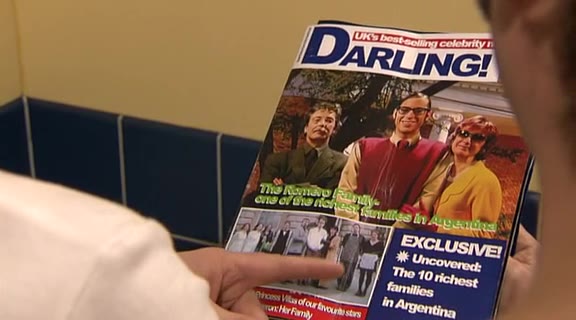
"Hector, is this you? The Romero family. One of the richest families in Argentina." —
"Yeah, I am hot. I need a shower." —
"Hector, please come out, we want to talk to you." —
"Hector, come and stay with me. I have two rooms." —
B. Correct these statements. First say No, …, then give the true fact.
Example: Annie's dog sleeps in the oven. — No, it doesn't. It sleeps in a basket.
1. Hector speaks English very well. — No, . He English very badly.
2. Bridget is happy when other people use her bicycle. — No, . She's .
3. Hector wants to have a bath after riding the bicycle. — No, . He wants to have a .
4. Hector's family is one of the poorest in Argentina. — No, . It's one of the .
5. At the end, Bridget wants Hector to leave her flat. — No, . She wants him to .
C. In this episode … Are these sentences true or false?
Hector arrives at the flat for the first time.
He has met Bridget before.
At first, Bridget and Annie think Hector is strange.
Nick teaches Hector some useful English expressions.
Nick finds out about Hector from a magazine.
Bridget and Annie also know about Hector's family.
Bridget's attitude changes when she sees Hector in the bathroom.
Nick invites Hector to live in his flat.
Say something extr@!

Meeting people for the first time
- Hello, I am called Hector.
- I am from Argentina.
- Nice to meet you.
A. Read and listen to the conversation between Hector, Annie and Bridget — the real scene from the episode. Why is it funny?
Hector: Hello.
Annie: Hello.
Hector: I am called Argentina. I am from Hector.
Annie: You mean "I am called Hector."
Hector: You are called Hector?
Annie: Oh, no, no, no, I am called Annie.
Hector: I am called Annie.
Bridget: No! She means "I am called Hector, I am from Argentina."
Hector: You are from Argentina!
Bridget: Oh! Come in!
B. Put Hector's words in the right order.
- Am
- called
- Hector
- I
- .
- Am
- I
- from
- Argentina
- .
Offering someone food and drink
- What would you like to eat?
- Would you like (to have) a coffee?
- Would you like some milk and sugar in it?
C. Complete these short conversations.
- To
- would
- you
- what
- eat
- like
- ?
- Like
- coffee
- some
- now
- you
- would
- ?
- And
- you
- sugar
- it
- in
- milk
- would
- like
- some
- ?
extr@ email!

Read these lines from emails in the programme. Who wrote them?
- Gigi!! Did you get my message? Please call me.
- I told you last night, it's finished. (And don't call me GIGI.)
- Hi, Nadia! Bridget's pen pal arrived this morning!
- The chicks in the apartment opposite have a visitor.
Who is John?
John is.
Tap what you hear. Two lines Nick and the girls say in Part two.
Language 1 — the present continuous
The present continuous — what's happening now
| I am (I'm) / I'm not | riding a bicycle |
| You are (You're) / You aren't | sitting on the sofa |
| He is (He's) / He isn't | writing an email |
| She is (She's) / She isn't | learning English |
| We are (We're) / We aren't | listening to music |
| They are (They're) / They aren't | eating a sandwich |
Spelling of -ing: sit → sitting (short verb, vowel + consonant: double the consonant) · read → reading (two vowels: no doubling) · open → opening (two syllables: no doubling) · dance → dancing (drop the e).
A. Write the -ing form.
1. ride →
2. shop →
3. have →
4. speak →
5. listen →
6. drink →
B. Complete the questions and answers.
1. Are you learning English? — Yes, . / No, .
2. Hector the exercise bicycle? — Yes, . / No, .
3. Is Annie an email? — Yes, . / No, .
4. Are we on the sofa? — Yes, we are. / No, .
5. they TV? — Yes, . / No, they aren't.
6. Are Hector and Bridget shopping? — Yes, they are. / No, .
Language 2 — the present simple
The present simple — facts and habits
I / you / we / they: I speak English. · I don't speak Spanish. · Do you speak Spanish? — Yes, I do. / No, I don't.
He / she: He speaks Spanish. · He doesn't speak English. · Does he speak English? — Yes, he does. / No, he doesn't.
A. Complete these sentences, using the verb in brackets.
1. Annie and Bridget in London.
2. They in Argentina.
3. Annie TV every day.
4. Nick Bridget.
5. Hector English very well.
B. Choose the verb that fits.
1. Iin Europe.
2. My best friendItalian fluently.
3. My cousinfor an oil company.
4. ISpanish very well.
Vocabulary of the episode
| Word | Meaning | |
|---|---|---|
| pen pal | n. | a friend you write letters to, usually in another country |
| parcel | n. | something wrapped in paper and sent by post |
| (electricity) bill | n. | a paper that says how much you must pay |
| butler | n. | the chief male servant in a rich house |
| servant | n. | a person who works in someone's house |
| landlady | n. | a woman who owns the flat you rent |
| rules | n. | what you may and may not do |
| luggage | n. | the bags you travel with |
| cushion | n. | a soft bag you put on a sofa |
| oven | n. | the part of a cooker where you bake food |
| shower | n. | you stand under it to wash |
| fancy | v. | to find someone attractive |
| stay with | v. | to live in someone's home for a short time |
| cry | v. | to have tears in your eyes |
| bring up | v. | to carry something upstairs |
| handsome | adj. | good-looking (about a man) |
| polite | adj. | saying please and thank you |
| old-fashioned | adj. | from an earlier time, not modern |
| awful | adj. | very bad |
| strange | adj. | unusual, not normal |
| sweet | adj. | kind and nice |
| what's she like? | tell me about her character | |
| be my guest | of course, go ahead | |
| keep a secret | not tell anybody |
Cultural references
- Ricky Martin — Puerto Rican pop star, very popular around 2000; Annie's idea of a "Latin American".
- Brad Pitt — Hollywood actor; the girls' idea of handsome.
- chicks — young-speaker slang for girls. Nick uses it in his email; don't use it yourself.
- fish and chips — the classic British takeaway; Hector hears "fish and ships".
Well done! Next time in extr@: Hector goes shopping.