A Puzzle for Logan
A PUZZLE FOR LOGAN
by Richard MacAndrew · Cambridge English Readers, Level 3 · Cambridge University Press
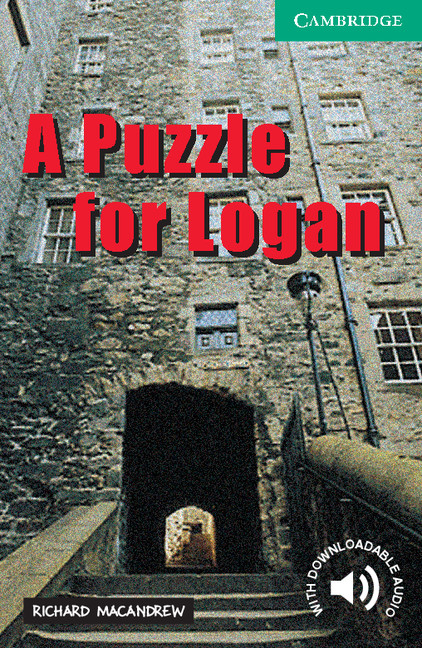
An interactive graded reader — read, listen and work through the story chapter by chapter.
A murderer escapes from a prison van on a summer afternoon. Hours later a young woman is found dead in a park in the middle of Edinburgh, her throat cut, an envelope with a name on it in her pocket. For Inspector Jenny Logan the answer looks obvious from the first minute — and that is exactly what worries her. The deeper she and Sergeant Grant dig, the more the case reaches back to another murder seven years old, and towards a man everybody in the city is too frightened to name.
People in the story
– Inspector Jenny Logan — a police officer in Edinburgh
– Sergeant Grant — an officer helping Inspector Logan
– Ronnie Campbell — in prison for murder
– Helen Robertson — a police doctor
– Jimmy Brown — a criminal
– Morag Mackenzie — Jimmy Brown's girlfriend
– Craig Sinclair — murdered seven years ago
– Jean Drummond — Craig Sinclair's sister
– Robert Baxter — a business man
– Angus (Gus) MacLeod — a homeless man
– Tam MacDonald — a journalist
Chapters
1. An escape and a murder
2. A visit to Jimmy Brown
3. The 'main man'
4. Bags of money
5. Questions for Robert Baxter
6. Catching Ronnie Campbell
7. A very good reason to kill
8. The mystery car
9. Back to the first murder
10. Catching a murderer
11. The last pieces of the puzzle
Part 1 — A day off interrupted
Jenny Logan was enjoying an afternoon of warm Scottish sunshine on the beach at Portobello, five kilometres from the centre of Edinburgh, when her phone rang.
'Logan.'
'Grant here, madam.'
'It's my day off, Grant,' said Logan.
'I know. I'm sorry,' said Grant. 'But Ronnie Campbell, the murderer, has escaped from prison.'
'OK,' said Logan. 'I'll meet you in my office in about fifteen minutes.'
She put on jeans and a T-shirt over her swimsuit and walked quickly to her car.
· · ·
Jenny Logan was an inspector in the Edinburgh Police. During the ten-minute drive from Portobello to the London Road police station, she thought about Ronnie Campbell. She knew that he had gone to prison for murdering a man called Craig Sinclair. That was about seven years ago, just after she had joined the police, but she couldn't remember anything else.
Sergeant Grant was waiting for Logan in her office. He was fifty-nine but looked younger. His hair was thick and black and he had a large black moustache. He was holding some papers with 'Police Record: Ronnie Campbell' written on the front.
'Tell me what's happening,' said Logan, putting her beach bag in a cupboard under the window.
'Campbell escaped from a prison van near Dundee some time this morning,' said Grant. 'They were moving him down to Saughton.' Saughton was a prison in the western part of Edinburgh. 'Campbell escaped at a petrol station and got away. We found out later he'd stolen a car, a dark blue Audi.'
'What have you done so far?' asked Logan.
'We've told the newspapers, the radio and the TV stations. We've given them the car number, and described what Campbell was wearing.'
Logan said nothing and thought for a moment.
'Is he dangerous, do you think?' she asked Grant. 'Possibly,' said Grant, putting Campbell's police record on Logan's desk and pointing to it. He opened his mouth to say something else but just then the phone rang. Grant answered it. He listened, said OK twice and then put the phone down. He looked at Logan.
'Someone's found a young woman's body in Holyrood Park. We're wanted over there immediately.'
'Today was my day off,' said Logan.
'Not any longer!' said Grant.
Key words — Part 1
| Word | POS | Meaning | In the story |
|---|---|---|---|
| escape | v | to get away from a place where you are being kept | Ronnie Campbell has escaped from prison. |
| murderer | n | a person who kills someone on purpose | Ronnie Campbell, the murderer |
| sergeant | n | a police officer of middle rank, below an inspector | Sergeant Grant was waiting for Logan. |
| moustache | n | hair that a man grows on his top lip | he had a large black moustache |
| police record | n phr | the official list of the crimes a person has been caught for | papers with 'Police Record: Ronnie Campbell' |
| petrol station | n phr | a place at the roadside where drivers buy petrol | Campbell escaped at a petrol station. |
| cupboard | n | a piece of furniture with a door, for keeping things in | putting her beach bag in a cupboard |
Logan was not at work when Grant telephoned her.
Ronnie Campbell went to prison for murdering Craig Sinclair.
Campbell escaped from Saughton prison.
Campbell stole a dark blue Audi after his escape.
Grant looks older than he really is.
The police gave the car number to the newspapers, the radio and the TV.
Ronnie Campbell from a prison van near Dundee and got away at a , and later he stole a dark blue Audi. Back at the London Road police station, Grant, a man with a large black , was holding Campbell's police , and Logan put her beach bag in a under the window.
- escape
- murderer
- sergeant
- moustache
- police record
- cupboard
- Else
- to
- his
- say
- mouth
- he
- opened
- something
- .
- For
- man
- prison
- to
- gone
- murdering
- a
- that
- Sinclair
- he
- Craig
- knew
- called
- had
- she
- .
Part 2 — A body in Holyrood Park
A few minutes later, Logan, with Grant beside her in the car, entered Holyrood Park. Holyrood Park is one of the most beautiful places in Edinburgh. Inside the park is Arthur's Seat, the tall hill that stands over all of Edinburgh. There are also lakes and fields. What other capital city in the world has such a large area of wild, green and open land so close to its centre? Edinburgh people know it well and love it; tourists do not often go there.
As she drove past the Palace of Holyroodhouse, the Queen's palace in Scotland, Logan remembered that in the middle of the sixteenth century there had been a very bloody murder inside the palace itself. She asked herself what they would find as she reached the group of police cars.
Logan parked her car on the grass at the side of the road behind the last police car. She got out and looked up at Arthur's Seat. The sky was blue and it was still warm, but Logan began to feel cold at the unfairness of a young woman's early death.
There was a group of people, almost all men, standing about a hundred metres away on the hillside. Logan and Grant walked up the hill towards the group. When they arrived, people moved back to let them through. Logan stepped forward and looked down at the body of a young woman in her late twenties. There was a wide cut across the woman's throat and blood everywhere. A dark-haired woman in blue trousers and a white shirt was studying the body carefully. This woman was Helen Robertson, the police doctor. Logan had met her a few times.
Key words — Part 2
| Word | POS | Meaning | In the story |
|---|---|---|---|
| palace | n | the official home of a king or queen | the Palace of Holyroodhouse |
| bloody | adj | with a lot of blood; violent | a very bloody murder inside the palace |
| unfairness | n | the fact that something has happened which should not have happened | the unfairness of a young woman's early death |
| hillside | n | the sloping side of a hill | standing about a hundred metres away on the hillside |
| let (someone) through | phr v | to allow someone to go past you | people moved back to let them through |
| in her late twenties | phr | aged about 27, 28 or 29 | a young woman in her late twenties |
| throat | n | the front of the neck | a wide cut across the woman's throat |
What did Logan remember as she drove past the Palace of Holyroodhouse?
- The text says tourists do not often go to the park.
- She remembers Robertson later, standing over the body.
- The text says nothing about a case of her own at the palace.
- Yes — a very bloody murder inside the palace in the middle of the sixteenth century.
Why did Logan begin to feel cold?
- The story does not say this.
- The story does not say this.
- "The sky was blue and it was still warm."
- "the unfairness of a young woman's early death"
Tap the three words that name a natural feature of the park.
Loganher car on the grass behind the last police car.
The dead woman was in hertwenties.
Helen Robertson was the police.
Part 3 — What the police doctor saw
'Helen,' said Logan softly.
Robertson looked up.
'Jenny,' she said. 'Hi. A bad business, I'm afraid.' She turned back to the body but went on talking. 'As you can see, someone cut her throat with a knife. It's almost cut her head away from her body and there's a lot of blood.' She pointed at the ground near the body.
'Time of death…Probably between two and three this afternoon.'
Robertson continued to move round the body. She touched it as little as possible, only when she needed to see something better.
'I can't be sure until I've carefully…' She stopped as she looked more closely at something.
'Yes?' said Logan.
'Well, look at how the cut starts at the bottom of the neck here on the right and finishes close to her left ear. I would say the killer stood behind her and held her head back with his right arm. Then he cut her throat, holding the knife in his left hand.'
'I see,' said Logan. 'How sure are you?'
'Sure enough,' said Robertson, looking up with a serious smile on her face. 'And I'd also say he, or she, is quite a bit taller than this woman.' She nodded her head at the body on the ground in front of her. 'And this woman's actually quite tall herself. I'd say about 165, 170 centimetres.'
'Thanks, Helen,' said Logan. 'If there's anything else…'
'I'll let you know,' finished Robertson. 'There is one other thing. The killer will probably have blood all over his clothes.'
'OK. That's useful.' Logan turned to Grant. 'We need to find the knife, if possible,' she said. 'Get some people to search the park.'
'Right, madam,' said Grant.
Key words — Part 3
| Word | POS | Meaning | In the story |
|---|---|---|---|
| softly | adv | quietly, in a gentle voice | 'Helen,' said Logan softly. |
| a bad business | phr | an unpleasant, serious situation | 'A bad business, I'm afraid.' |
| as little as possible | phr | only the smallest amount you can | She touched it as little as possible. |
| closely | adv | carefully and from a short distance | She looked more closely at something. |
| nod | v | to move your head down and up | She nodded her head at the body. |
| quite a bit | phr | a lot; much more | he is quite a bit taller than this woman |
| search | v | to look carefully all over a place | Get some people to search the park. |
Robertson thought the woman died between two and three in the afternoon.
The killer cut the woman's throat with his right hand.
Robertson believed the killer was taller than the dead woman.
The dead woman was a short woman.
Robertson thought the killer's clothes would have blood on them.
Robertson was completely sure about everything from the start.
- Logan says Helen's name quietly and the doctor looks up.
- Robertson warns that the killer will have blood on his clothes.
- Robertson gives a probable time of death.
- Robertson looks more closely and describes how the killer stood.
- Robertson explains that someone cut the woman's throat with a knife.
- Robertson says the killer was taller than the dead woman.
- Logan tells Grant to have the park searched.
Logan spoke so to the police doctor, who said it was a bad bu. Robertson touched the body as li as possible, and then she stopped and looked more cl at the cut. She no her head at the body and said that the killer was quite a b taller than the dead woman.
Part 4 — A name in the pocket
Logan looked at her watch. It was only five o'clock. It would be light for a long time yet. 'The park's a big place but they can look till it gets dark,' she said. 'They've probably got another four or five hours at least.'
Grant moved away and started giving orders to some of the police officers standing around. Logan walked some metres away from the body and allowed the sunshine and fresh air to take away some of the coldness of death.
A few minutes later, Grant came back towards Logan with Helen Robertson.
'I found this in her pocket,' said Robertson, passing Logan a clear plastic police bag with a rather dirty envelope inside it.
Logan took the bag and held it carefully so that she could look inside the envelope. It was empty. On the back of the envelope there were a few words: eggs, bread, milk, matches. Someone's shopping list. On the front was the name Morag Mackenzie but no address.
'You haven't had time to read Ronnie Campbell's police record,' said Grant, 'but the name Morag Mackenzie is in it. She's not one of his favourite people.'
Logan gave the bag and the envelope back to Helen.
'Helen, could you give this to the scientists,' she said. 'I want to know if there are any fingerprints on it. And I want to know if they can tell me anything about the handwriting.'
Logan turned to Grant. 'Well,' she said, 'it looks as if Ronnie Campbell may be dangerous. You'd better tell me what you know about him.'
Key words — Part 4
| Word | POS | Meaning | In the story |
|---|---|---|---|
| envelope | n | the paper cover a letter is sent in | a rather dirty envelope inside it |
| shopping list | n phr | a note of the things you must buy | eggs, bread, milk, matches — someone's shopping list |
| fingerprint | n | the mark your finger leaves on what you touch | if there are any fingerprints on it |
| handwriting | n | the way a particular person writes by hand | if they can tell me anything about the handwriting |
| scientist | n | one of the people who test the things found at a crime, for the police | could you give this to the scientists |
| it looks as if | phr | it seems that | it looks as if Ronnie Campbell may be dangerous |
| give orders | phr | to tell people what they must do | Grant started giving orders. |
| you'd better | phr | you should — and there will be trouble if you do not | You'd better tell me what you know about him. |
What was inside the clear plastic police bag?
- The knife had still not been found.
- Yes — a rather dirty envelope with the name Morag Mackenzie on the front.
- Grant had left that on Logan's desk at the station.
- The shopping list was written on the envelope, and there was no money.
Why does the name on the envelope interest Logan?
- The story does not say this.
- Nobody had examined the handwriting yet.
- The police doctor is Helen Robertson.
- Grant tells her: 'the name Morag Mackenzie is in it'.
- envelope
- fingerprint
- handwriting
- shopping list
- scientist
- give orders
- About
- me
- know
- him
- better
- You'd
- tell
- you
- what
- .
Review — Chapter 1
- Robertson gives Logan an envelope she has found in the dead woman's pocket.
- A telephone call tells them that a body has been found in Holyrood Park.
- Logan tells Grant to have the park searched for the knife.
- Grant telephones Logan on the beach and tells her that Ronnie Campbell has escaped.
- Grant tells Logan that the name on the envelope is in Campbell's police record.
- Helen Robertson describes the cut and says the killer was taller than the dead woman.
- Logan drives to the London Road police station and meets Grant in her office.
- Grant explains how Campbell got away from the prison van and stole a car.
Which TWO of these things does the police doctor tell Logan about the killer?
- Robertson says the killer was quite a bit taller.
- Yes — 'The killer will probably have blood all over his clothes.'
- The woman's throat was cut with a knife.
- Robertson says nothing about that — it is Grant who connects the name on the envelope to Campbell's record.
- Yes — he held her head back with his right arm and cut with the knife in his left hand.
- escape
- police record
- petrol station
- moustache
- cupboard
- sergeant
- throat
- hillside
- envelope
- handwriting
- fingerprint
- palace
On her day off, Inspector Logan learns that a has escaped from a prison van and got away at a petrol station. Later that afternoon a young woman is found dead in Holyrood Park with a wide cut across her . The police doctor says the killer stood behind her, held the knife in his left hand, and was quite a bit than the dead woman. In the woman's pocket Robertson finds a dirty with a shopping list on the back and the name Morag Mackenzie on the front. Logan asks the scientists to look for and to study the .
Which word means 'the official list of the crimes a person has been caught for'?
- That is the building where police officers work.
- Yes — Grant is holding Campbell's police record.
- That is the mark your finger leaves on what you touch.
- That is a note of the things you must buy.
Which word means 'a lot; much more'?
- That means only the smallest amount you can.
- That means carefully and from near.
- Yes — the killer was quite a bit taller than the dead woman.
- That means quietly, in a gentle voice.
Grammar — Past Simple
Grammar help — the Past Simple in a story
A story like this one is told in the Past Simple. Each verb is one finished action, and the actions come one after another in the order they happened:
She got out and looked up at Arthur's Seat.
Regular verbs end in -ed: look → looked, park → parked, walk → walked, point → pointed.
Many common verbs are irregular — you have to learn the form. These all come from Chapter 1:
| Base form | Past Simple | In Chapter 1 |
|---|---|---|
| say | said | 'It's my day off, Grant,' said Logan. |
| put | put | She put on jeans and a T-shirt. |
| think | thought | Logan said nothing and thought for a moment. |
| get | got | She got out and looked up at Arthur's Seat. |
| begin | began | Logan began to feel cold. |
| stand | stood | The killer stood behind her. |
| hold | held | Logan took the bag and held it carefully. |
| take | took | Logan took the bag. |
| find | found | 'I found this in her pocket.' |
| give | gave | Logan gave the bag and the envelope back to Helen. |
| know | knew | She knew that he had gone to prison. |
| cut | cut | Someone cut her throat with a knife. |
Watch out: put, cut and let do not change at all — only the sentence tells you it is the past.
Tap the six verbs that are in the Past Simple.
Logan on jeans and a T-shirt over her swimsuit.
Grant , 'Ronnie Campbell has escaped from prison.'
The killer behind her and her head back.
Logan the bag and it back to Helen.
Logan her car on the grass and out. She up at Arthur's Seat and to feel cold. A few minutes later Grant back with Helen Robertson, who Logan an envelope.
- Body
- the
- move
- continued
- round
- to
- Robertson
- .
- Younger
- was
- fifty-nine
- looked
- he
- but
- .
- Metres
- Logan
- body
- some
- the
- away
- from
- walked
- .
Part 1 — The case against Ronnie Campbell
'We were lucky to catch Campbell for Craig Sinclair's murder,' said Grant, as he and Logan walked down the hill towards her car.
'Did you work on the murder?' asked Logan.
'Yes, but before you ask, I didn't speak to Morag Mackenzie then and I don't know if that's her up there,' said Grant, pointing back up the hillside with his thumb. 'At first we didn't have any idea at all who'd killed Sinclair. Then someone rang the London Road police station, didn't leave a name, but said we should search Campbell's flat.'
'And what was there?' asked Logan.
'There was a gun in a metal box in his kitchen. It was the gun which had killed Sinclair. Campbell's fingerprints were all over the box.'
'What about the gun?'
'None. No fingerprints on the gun,' said Grant. 'He'd probably cleaned it. Anyway, they were still questioning him when Morag Mackenzie came into the police station. I wasn't there at the time. She said she'd seen Campbell and Sinclair drinking together and shouting at each other on the night that Sinclair died. The two of them had been in that pub at the end of Rose Street, the Abbotsford Arms.'
'What did Campbell have to say?' asked Logan.
'Well, he said the box was his but he'd never seen the gun. He also said he'd never been in the Abbotsford Arms in his life. He said he didn't know Sinclair very well at all so why would he kill him?'
'But you were sure you had the right person,' said Logan.
'Oh yes,' said Grant. 'Campbell had been in trouble quite a few times. He'd been to prison twice: once for stealing cars and once for fighting in a pub. He broke someone's arm.'
'That doesn't make him a murderer,' said Logan.
'True,' said Grant, 'but you wouldn't be surprised if he was.'
'What about Sinclair?' asked Logan.
'A small-time criminal, too. He'd never been to prison but that was just good luck. He got into fights; he sold stolen CDs, things like that.'
'Nice people,' said Logan.
Key words — Part 1
| Word | POS | Meaning | In the story |
|---|---|---|---|
| catch | v | to find someone and take them to prison | We were lucky to catch Campbell. |
| thumb | n | the short thick finger at the side of your hand | pointing back up the hillside with his thumb |
| flat | n | a home on one floor inside a bigger building | We should search Campbell's flat. |
| question | v | to ask someone many questions about a crime | They were still questioning him. |
| in trouble | phr | caught doing something that is against the law | Campbell had been in trouble quite a few times. |
| steal | v | to take something that is not yours | once for stealing cars |
| small-time criminal | n phr | a person who does small crimes, not big ones | A small-time criminal, too. |
Grant worked on the Craig Sinclair murder.
Grant spoke to Morag Mackenzie seven years ago.
Someone telephoned the police station but did not leave a name.
The police found Campbell's fingerprints on the gun.
Campbell said he had never been in the Abbotsford Arms.
Craig Sinclair had been to prison twice.
- catch
- thumb
- flat
- question
- steal
- small-time criminal
- It
- was
- Sinclair
- which
- had
- killed
- gun
- the
- .
- Him
- make
- doesn't
- murderer
- that
- a
- .
Part 2 — Logan studies the record
At six o'clock, back at the London Road police station, Logan sent Grant to find out the latest news about Ronnie Campbell and the dark blue Audi. At last she had time to change out of her beach clothes into a dark blue trouser suit that she always kept in her office. She felt more comfortable at work if she wore smart clothes. She studied her face in the mirror. She had short brown hair and dark brown eyes, but she always thought her nose was rather too long. A journalist friend of hers, Tam MacDonald, said she was too pretty to be a police officer. She had been angry with him when he said this. She was intelligent and good at her job, and it was an important job. However, it was sometimes difficult being a woman police officer. Because she was good-looking, people did not always take her seriously. She worked hard to show those people they were wrong.
Logan got herself a cup of coffee. Then she opened Ronnie Campbell's record and looked at his photo. There was nothing interesting or unusual about him. He was thirty-five years old, 180 cm tall, with brown hair and brown eyes. The hair was short and straight, the eyes small and close together. He was described as slim and quite strong. As Logan looked at the photo, she began to ask herself questions. Why had Campbell escaped? Was that Morag Mackenzie's body in Holyrood Park? Had Morag seen Campbell in the Abbotsford Arms seven years ago? Had Campbell killed her? In fact, had he really killed Craig Sinclair? And where was he now? He wouldn't need new clothes because prisoners in Scotland wore their own clothes. But he would need money – where would he get it?
Key words — Part 2
| Word | POS | Meaning | In the story |
|---|---|---|---|
| smart | adj | neat and tidy, right for work | She felt more comfortable if she wore smart clothes. |
| mirror | n | a piece of glass you can see yourself in | She studied her face in the mirror. |
| journalist | n | a person who writes for a newspaper | A journalist friend of hers, Tam MacDonald |
| take (someone) seriously | phr | to believe that someone is good at their job | People did not always take her seriously. |
| good-looking | adj | pretty; nice to look at | Because she was good-looking |
| unusual | adj | different from what is normal | nothing interesting or unusual about him |
| slim | adj | thin, in a nice way | He was described as slim and quite strong. |
- Logan changes out of her beach clothes into a dark blue trouser suit.
- Logan gets herself a cup of coffee.
- Logan asks herself why Campbell escaped and where he is now.
- Logan studies her face in the mirror and remembers what Tam MacDonald said.
- Logan opens Ronnie Campbell's record and looks at his photo.
- Logan sends Grant to find out the latest news about Campbell and the Audi.
Logan changed into a dark blue trouser suit because she felt more comfortable at work in sm clothes. She studied her face in the mi and remembered that a jo friend had said she was too pretty to be a police officer. Because she was good, people did not always take her seriously. In Ronnie Campbell's record there was nothing interesting or un about him, and he was described as sl and quite strong.
Logan sent Grant to find out the latestabout Ronnie Campbell.
She always kept a dark blue trouser suit in her.
In his photo, Campbell's hair was short and.
Part 3 — Finding Jimmy Brown's flat
At that moment Grant returned.
'No news on Campbell or the Audi, I'm afraid,' he said. 'But I'm sure that was Morag Mackenzie's body on the hillside.'
'Why?' asked Logan.
'Some of the officers downstairs knew her and described her to me. She lived with a man called Jimmy Brown and he's no good at all. He's part of all sorts of criminal activities: robbery, stealing cars, everything.'
'We'll need him to look at the body so that we're sure it's her,' said Logan. And even though it seems Ronnie Campbell killed her, we'll also need to ask Mr Brown some questions. We need to know where he was this afternoon. As we know, women are most often murdered by their husband or boyfriend. Have you got an address for him?'
'Yes,' replied Grant. 'Springwell Place. Off Dairy Rd.'
'OK,' said Logan. 'Let's go.'
The flat which Jimmy Brown shared with Morag Mackenzie was on the second floor of an old building near Dairy Road. Grant parked the car in the street outside and followed Logan up the stairs. Their knock was answered by a young fair-haired man who badly needed a bath and a change of clothes. He was wearing a dirty red T-shirt, jeans which a long time ago had been white, and no shoes or socks. He was tall and looked down at Logan with an ugly smile on his face. He turned and looked at Grant and then back to Logan.
'Well,' he said, 'it's the pigs.'
Key words — Part 3
| Word | POS | Meaning | In the story |
|---|---|---|---|
| no good | phr | bad; not honest | He's no good at all. |
| all sorts of | phr | many different kinds of | He's part of all sorts of criminal activities. |
| robbery | n | the crime of taking things from a person or a place | robbery, stealing cars, everything |
| knock | n | the sound of hitting a door with your hand | Their knock was answered by a young man. |
| fair-haired | adj | with light-coloured hair | a young fair-haired man |
| ugly | adj | unkind and unpleasant | an ugly smile on his face |
| pigs | n | a rude word for police officers | 'Well,' he said, 'it's the pigs.' |
Why does Logan want Jimmy Brown to look at the body?
- Brown is part of all sorts of criminal activities.
- Yes — 'We'll need him to look at the body so that we're sure it's her.'
- The story does not say this.
- She says it seems Ronnie Campbell killed her, but she still wants to ask Brown some questions.
What did the man who opened the door look like?
- Sergeant Grant has thick black hair and a large black moustache, but this man was young, tall and fair-haired.
- That is the description of Ronnie Campbell in his police record.
- He was young, his T-shirt was dirty and red, and he had no shoes at all.
- Yes — a young fair-haired man who badly needed a bath and a change of clothes, and he was tall.
Grant said that Morag Mackenzie had lived with Jimmy Brown, a man who was at all and who was part of criminal activities, including . Logan and Grant drove to his flat near Dairy Road, and their was answered by a young man with an smile on his face.
Review — Chapter 2
- Grant tells Logan that someone rang the police station about Campbell's flat.
- Logan looks at the photo in Ronnie Campbell's record and asks herself questions.
- Grant describes the gun the police found in a metal box in Campbell's kitchen.
- Grant tells Logan that Morag lived with a man called Jimmy Brown.
- Logan and Grant climb the stairs to the flat near Dairy Road.
- Grant returns and says there is no news about Campbell or the Audi.
- Back at the station, Logan changes into a dark blue trouser suit.
- Grant explains that Morag Mackenzie came to the station while Campbell was being questioned.
Which TWO of these things did Ronnie Campbell say to the police seven years ago?
- The story does not say this.
- He said he didn't know Sinclair very well at all.
- Yes — 'he said the box was his'.
- That is what Grant thinks: 'He'd probably cleaned it.' Campbell said he had never seen the gun.
- Yes — 'he'd never been in the Abbotsford Arms in his life'.
- catch
- thumb
- flat
- question
- steal
- small-time criminal
- robbery
- knock
- fair-haired
- ugly
- mirror
- journalist
Someone rang the police station and said the police should search Campbell's , where they found a gun in a metal box. Campbell had been in many times before: he had been to prison once for cars and once for fighting. Back at the station, Logan studied her face in the and remembered that a friend had said she was too pretty to be a police officer. Later, Grant told her that Morag Mackenzie had lived with Jimmy Brown, a man who took part in and other crimes.
Which word means 'a person who does small crimes, not big ones'?
- That is a person who writes for a newspaper.
- Yes — Grant says Craig Sinclair was a small-time criminal.
- That is a person whose job is to catch criminals.
- That is a person who is being kept in prison.
Which word means 'neat and tidy, right for work'?
- That means different from what is normal.
- Yes — Logan felt more comfortable at work if she wore smart clothes.
- That means thin, in a nice way.
- That means unkind and unpleasant.
Grammar — Past Perfect
Grammar help — the Past Perfect
Chapter 2 tells two stories at the same time: today (a body on the hillside) and the older story of Craig Sinclair's murder seven years ago. When the writer steps back from the main past story to something that happened earlier, the verb changes to the Past Perfect.
had + past participle: It had killed Sinclair.
In speech it is almost always short: had → 'd. That is why the chapter is full of who'd, he'd and she'd:
'At first we didn't have any idea at all who'd killed Sinclair.'
Negative: had never / hadn't + past participle. Question: Had + person + past participle.
| Base form | Past Perfect in Chapter 2 | In the story |
|---|---|---|
| kill | had killed | It was the gun which had killed Sinclair. |
| clean | had cleaned | He'd probably cleaned it. |
| see | had seen | She said she'd seen Campbell and Sinclair drinking together. |
| be | had been | The two of them had been in that pub at the end of Rose Street. |
| see | had never seen | he said the box was his but he'd never seen the gun |
| be | had never been | He also said he'd never been in the Abbotsford Arms in his life. |
| be | had been | He'd been to prison twice. |
| escape | had escaped | Why had Campbell escaped? |
| kill | had killed | Had Campbell killed her? |
Watch out: the main story stays in the Past Simple (said, walked, opened). Use the Past Perfect only for the step back to an earlier time.
Tap the five past participles.
The gun in the metal box was the gun which Craig Sinclair.
Campbell said that he the gun.
Morag Mackenzie said that she the two men in a pub.
When Grant came back, Logan into a dark blue trouser suit.
Grant told Logan that seven years earlier someone Craig Sinclair, and he thought that Campbell the gun. Morag Mackenzie told the police that she the two men in a pub, and Campbell someone's arm in an earlier fight. That evening Logan Campbell's record and asked herself why he .
- Well
- very
- all
- Sinclair
- he
- he
- know
- said
- at
- didn't
- .
- Escaped
- Campbell
- why
- had
- ?
- Were
- worked
- they
- she
- show
- wrong
- to
- people
- hard
- those
- .
Part 1 — The pigs at the door
People call the police a lot of different names: bobbies, coppers, the cops, and other worse things. The one thing all police officers really hate being called is 'pigs'. As soon as she heard the word, Logan felt Grant move beside her. She reached out her hand and put it on his arm.
'No,' she said softly. She looked at the man in front of her. 'Jimmy Brown?' she asked.
'Maybe,' he said. 'Who wants to know?'
'Jimmy, I'm Inspector Logan of the Edinburgh Police and this is Sergeant Grant.' She showed him her ID card then put it away in her bag.
'So?' said Jimmy, continuing to look down his nose at her.
'So we'd like to come in,' explained Grant, putting his face very close to the other man's face. Brown took a couple of steps back. Grant and Logan stepped quickly into the flat and Grant shut the door. Brown looked surprised.
'Problem?' asked Grant. His voice did not sound friendly. He did not look friendly.
Brown gave a weak smile and moved back against the wall.
Logan took a few more steps into the flat and looked around. She had been in some terrible flats in the past but she had never seen anywhere quite like this. The furniture was old and had cigarette burns all over it. The walls were a dark colour; probably once a kind of brown but it was difficult to tell. Coffee cups and cigarette packets lay everywhere. Empty pizza boxes lay on the table; that day's evening paper was open on a chair; a half-eaten piece of pizza lay on the floor by an empty beer can on its side. There was a smell of unwashed clothes and unwashed people.
She turned to Jimmy Brown.
'Do you know where Morag is, Jimmy?'
Brown moved away from Grant and walked round the room picking up empty cigarette packets and shaking them.
'No,' he said.
'What were you doing this afternoon?'
'Nothing.'
'Come on, Jimmy, let's have some answers,' said Logan, impatiently.
Grant looked round the room. There was a door to his left. He reached out to open it.
'Don't go in there,' said Brown, moving towards Grant.
Grant looked once at Brown and opened the door.
'Well, well, well,' said Grant, sounding very pleased with himself, as he looked through the door he had just opened. 'What have we got here?'
Logan took a step forward to see what Grant had found. There was a bed in one corner of the room, but all along the opposite wall were boxes of videos, televisions and CD players all on top of each other. Grant walked into the room and opened some of the boxes, checking what was inside.
Key words — Part 1
| Word | POS | Meaning | In the story |
|---|---|---|---|
| look down your nose at | phr | to behave as if you are better than someone | continuing to look down his nose at her |
| weak | adj | not strong; small and unsure | Brown gave a weak smile. |
| furniture | n | tables, chairs and other big things in a room | The furniture was old. |
| burn | n | a mark made on something by fire or something hot | cigarette burns all over it |
| impatiently | adv | in an annoyed way, because you do not want to wait | 'Let's have some answers,' said Logan, impatiently. |
| pleased with yourself | phr | happy because you have done something well | sounding very pleased with himself |
| opposite | adj | on the other side, facing you | all along the opposite wall were boxes |
Police officers hate being called 'pigs'.
Logan put her hand on Grant's arm to stop him.
Logan showed Jimmy Brown her ID card.
Brown politely invited the two officers into his flat.
There were cigarette burns all over the furniture.
Brown told Logan where Morag was.
Grant found boxes of videos, televisions and CD players in the other room.
Logan stepped into the flat and saw that the was old, with cigarette all over it. Brown gave a smile and moved back against the wall. 'Come on, Jimmy, let's have some answers,' said Logan, . Then Grant opened a door and saw boxes of videos and televisions all along the wall.
- furniture
- burn
- weak
- impatiently
- opposite
- look down your nose at
- Voice
- sound
- not
- his
- friendly
- did
- .
- Couple
- of
- back
- a
- steps
- Brown
- took
- .
Part 2 — Morag's mysterious main man
Brown sat down on the floor in the living room, looking unhappily at the wall on the other side of the room.
'Am I right in thinking that these are all stolen?' asked Logan.
Brown nodded but did not speak.
'It's not your lucky day, is it?' continued Logan. 'You're in big trouble now, Jimmy. And it'll be much worse if we don't get some answers. So where's Morag?'
'I really don't know,' said Brown. 'She went out about midday.'
'Where? Was she working?'
'No, she doesn't work much,' said Brown. 'Not a real job, anyway. Not a nine to five kind of job.'
'Where does she get money?' asked Logan, as Grant came back into the living room.
'I really don't know,' said Brown very quickly. 'Some man. She calls him her "main man". She gets money from him sometimes.'
'You're joking,' said Grant. 'You expect us to believe that some man just gives Morag money. Why? What does she do?'
'It's true. Really. It's true. I don't know what she does for him.'
'You don't know who this "main man" is, then?' asked Logan.
'No,' said Brown.
'No idea?' asked Grant, looking hard at Brown.
'I think he's someone important,' said Brown quickly, 'but she's never told me. She always says there are some things it's better not to know.'
'So you don't know what she did for him?'
'No,' said Brown.
'Was she going to see him today?' asked Logan.
'Probably,' said Brown. 'She made a phone call just before she went out. It sounded as if she was talking to him. In fact, it sounded as if she wanted to see him. Why are you asking all these questions about Morag anyway? What's she done?'
Logan stopped speaking. She looked out of the window and thought about the main man. How important was he? Grant continued the questioning.
'What about you, Jimmy?' he asked. 'Where have you been all day?'
'Here,' said Brown. 'I've been here. I haven't been out all day.'
'Is there anyone who's seen you or been with you?' Grant asked.
'No,' said Brown.
'No visitors?'
'No.'
Brown got up off the floor and started looking a little braver than before.
'Now, come on, you two. I've answered your questions,' he said. 'What's all this about? What's Morag been doing?'
Logan looked at Grant. Grant sat down on the arm of the cleanest chair.
'Jimmy,' he said, 'you'd better sit down. I'm afraid I've got some bad news for you.'
Key words — Part 2
| Word | POS | Meaning | In the story |
|---|---|---|---|
| stolen | adj | taken by a thief | Am I right in thinking that these are all stolen? |
| in big trouble | phr | in a very bad situation | You're in big trouble now, Jimmy. |
| be joking | v phr | to say something that is not serious | 'You're joking,' said Grant. |
| expect | v | to think that someone will do something | You expect us to believe that. |
| nine to five | phr | with normal working hours | Not a nine to five kind of job. |
| brave | adj | not afraid | looking a little braver than before |
| in fact | phr | the truth is | In fact, it sounded as if she wanted to see him. |
What does Brown tell Logan about Morag's 'main man'?
- Brown says Morag does not have a real job.
- Yes — 'She gets money from him sometimes.'
- Brown only says he thinks the man is someone important.
- The story does not say this.
Why does Brown think Morag was going to see the main man that day?
- Yes — and it sounded as if she wanted to see him.
- Brown says there were no visitors that day.
- Brown says, 'I really don't know.'
- Morag does not have a real job.
Logan asked Brown if the things in the bedroom were all.
Morag did not have a nine tokind of job.
Brown got up off the floor and started looking a littlethan before.
Part 3 — The evening paper mistake
They drove from Jimmy Brown's flat to the London Road police station. Grant and Logan sat in the front of the car, Brown in the back. He had cried when Grant told him about Morag. When he had stopped crying, they told him he would have to come to the police station. He would have to look at the body so that they could be sure it was Morag. He would also have to talk to officers from the Robbery Unit about what was in his bedroom. Logan didn't tell him that she would have some more questions for him later.
As Grant drove, Logan thought about the people who had come into her life today: Ronnie Campbell, murderer; Jimmy Brown, robber; Morag Mackenzie, dead at the age of… How old was she? Twenty-six? Twenty-seven? Certainly not much older.
When they arrived at the police station, it was seven thirty. Logan asked a young sergeant to take Brown to look at the body. As soon as they had left, she turned to Grant.
'He wasn't telling the truth about this afternoon,' she said.
'Wasn't he?' asked Grant.
'No,' replied Logan. 'He had this evening's paper in the flat. The evening paper comes out at about two o'clock. So either he went out to buy it or a visitor brought it in.'
'You didn't question him about it,' said Grant.
'No. I thought I'd leave it till later,' said Logan. 'He might talk more easily here.'
Grant smiled and then said, 'He's left-handed.'
'Yes, I saw,' said Logan. And tall.'
'And he's not a very nice person.'
'No,' said Logan. 'But that doesn't make him a murderer.'
'True,' said Grant. 'But you wouldn't… '
'… be surprised if he was,' finished Logan, smiling. 'And what about the main man?' she asked.
'It's an interesting choice of words, isn't it?' said Grant.
'Yes,' said Logan. 'It is unusual. But I've heard it before.'
'Someone who thinks they're important,' said Grant, more to himself than to Logan.
'Right,' said Logan, putting a hand on Grant's shoulder. 'When Jimmy's had a look at the body, lock him up and get someone from the Robbery Unit to go and talk to him about all those stolen things. They'll also need to go round to his flat and pick everything up. Then come and find me in my office.'
'Right,' said Grant.
Key words — Part 3
| Word | POS | Meaning | In the story |
|---|---|---|---|
| robber | n | a person who steals things | Jimmy Brown, robber |
| certainly | adv | you are sure about it | Certainly not much older. |
| tell the truth | phr | to say what really happened | He wasn't telling the truth about this afternoon. |
| come out | phr v | to be printed and sold | The evening paper comes out at about two o'clock. |
| left-handed | adj | using the left hand to write and do things | 'He's left-handed.' |
| unusual | adj | different from what is normal | 'It is unusual.' |
| lock (someone) up | phr v | to put someone in a locked room at a police station | lock him up and get someone from the Robbery Unit |
- Logan says that Brown was not telling the truth about his afternoon.
- Logan explains that the evening paper comes out at about two o'clock.
- Grant, Logan and Brown drive from the flat to the London Road police station.
- Logan tells Grant to lock Brown up and to call the Robbery Unit.
- Logan says that she has heard the words 'main man' before.
- Grant says that Brown is left-handed.
- A young sergeant takes Brown away to look at the body.
How does Logan know that Brown did not stay in the flat all afternoon?
- Brown says nobody saw him and nobody came to the flat.
- Yes — the paper comes out at about two o'clock, so he went out to buy it or a visitor brought it in.
- He said, 'I've been here. I haven't been out all day.'
- The story does not say this.
Logan thought about Morag Mackenzie, who was twenty-six or twenty-seven, ce not much older. At the police station she told Grant that Brown had not told them the tr about the afternoon, because the evening paper co out at about two o'clock. Grant had also seen that Brown was le, and Logan said that the words 'main man' were un. She told Grant to lo Brown up and to get the Robbery Unit to talk to him.
Part 4 — Divers and a missing knife
Logan was reading through Ronnie Campbell's police record and making notes in a small black notebook when Grant returned. As he came through the door, she looked at her watch. It was eight fifteen but it was still very light outside.
'The body is Morag Mackenzie's,' Grant told Logan.
'Yes, someone rang to tell me,' she replied. Any news on the envelope or the knife?'
'The scientists will call us as soon as possible about the envelope. The search has finished and they haven't found a knife.'
'What about St Margaret's Loch? Maybe the killer threw the knife in the water,' said Logan. St Margaret's Loch was a small man-made lake in Holyrood Park. 'Get some divers to check that in the morning.'
'Right, madam,' said Grant.
'Do we have any idea where Campbell might go?' she asked.
'Not really,' said Grant. 'I spoke to the prison. He had one visitor in the last twelve months: his lawyer.'
'Of course, at this time of year it's warm enough to sleep outside,' Logan said. She went on: 'I've also been thinking about how he'll get money.'
'He'll probably steal it,' said Grant.
Logan said nothing for a few moments. Then she spoke: 'Campbell was sent to prison for fifteen years.'
'That's right,' said Grant.
'He's still got quite a long time left,' said Logan.
'Yes,' agreed Grant. 'And because he's in trouble again now, he won't get out early. He'll be in there for eight more years.'
'There's something strange about this murder,' said Logan. 'I think if we want to find out who murdered Morag Mackenzie we'll need to look into Craig Sinclair's murder again.'
Grant looked at her but said nothing. He had only worked with Inspector Logan for three years, but he knew that she was often right.
Key words — Part 4
| Word | POS | Meaning | In the story |
|---|---|---|---|
| as soon as possible | phr | at the first moment you can | The scientists will call us as soon as possible. |
| man-made | adj | made by people, not by nature | a small man-made lake in Holyrood Park |
| diver | n | a person who swims under water to look for things | Get some divers to check that in the morning. |
| lawyer | n | a person whose job is to help people with the law | He had one visitor: his lawyer. |
| agree | v | to say that you think the same | 'Yes,' agreed Grant. |
| strange | adj | not normal; hard to understand | There's something strange about this murder. |
| look into | phr v | to try to find out about something | we'll need to look into Craig Sinclair's murder again |
The police have finished the search but they have not found the knife.
Logan wants divers to look in St Margaret's Loch.
Campbell had a lot of visitors in prison.
Grant thinks Campbell will steal the money he needs.
Campbell will get out of prison early because he is in trouble again.
Logan wants to look into Craig Sinclair's murder again.
- diver
- man-made
- lawyer
- agree
- strange
- look into
- For
- fifteen
- to
- prison
- Campbell
- years
- sent
- was
- .
Part 5 — Sinclair's sister in the New Town
Logan looked through a few pages of her notebook.
'Craig Sinclair had a sister,' she said. 'Jean Drummond, married. There's an address for her in the New Town, St Stephen Street. Let's see if she still lives there. Go and organise the divers for tomorrow and I'll meet you in the car park in ten minutes.'
'What about Jimmy Brown?' asked Grant.
'Let the Robbery Unit talk to him tonight,' said Logan. 'We'll talk to him tomorrow. I'm more interested in finding out about Sinclair's murder at the moment.'
The Old Town of Edinburgh is a fairly small area around the Castle and the Palace of Holyroodhouse. St Stephen Street is in the New Town, not far from Princes Street. And although this part of the city is already more than two hundred years old, it is still called the New Town.
As they drove through the streets of Edinburgh at eight thirty on this warm June evening, Logan looked at the busy streets and the stone houses. She thought to herself, as she often did, that Edinburgh must be one of the most beautiful cities in the world. She had been to London once but she hadn't liked it. London was too big, too noisy, too dirty. Edinburgh was just right.
As they turned into St Stephen Street and parked, the car phone rang. Grant picked it up. He listened for a minute, then said goodbye and put the phone down.
'They've found the Audi,' he said. 'In a car park near the Haymarket Station.'
'That's near Dairy Road,' said Logan, 'where Morag Mackenzie was living.'
'Yes. They're searching the area but Campbell could be anywhere by now. He won't go back to the car. That would be completely stupid.'
'True,' said Logan. 'OK. Let's go and see what Sinclair's sister has to say.'
Key words — Part 5
| Word | POS | Meaning | In the story |
|---|---|---|---|
| organise | v | to plan and arrange something | Go and organise the divers for tomorrow. |
| car park | n phr | a place where you leave your car | I'll meet you in the car park in ten minutes. |
| fairly | adv | quite, but not very | a fairly small area around the Castle |
| area | n | a part of a town or country | a fairly small area around the Castle |
| noisy | adj | full of loud sound | London was too big, too noisy, too dirty. |
| by now | phr | in all the time up to now | Campbell could be anywhere by now. |
| stupid | adj | very silly; not clever | That would be completely stupid. |
Why is this part of Edinburgh still called the New Town?
- They are more than two hundred years old.
- The Old Town is a different area, around the Castle and the Palace of Holyroodhouse.
- Yes — 'although this part of the city is already more than two hundred years old, it is still called the New Town.'
- Logan hopes that Jean Drummond still lives in St Stephen Street.
Tap the three words that Logan uses to describe London.
- There
- see
- lives
- she
- if
- still
- let's
- .
Review — Chapter 3
- Grant opens a door and finds boxes of stolen videos, televisions and CD players.
- Grant tells Brown the bad news about Morag.
- Grant and Logan step into Jimmy Brown's flat and Brown moves back against the wall.
- They drive to the police station and a sergeant takes Brown to look at the body.
- Logan explains that the evening paper in the flat shows that Brown was not telling the truth.
- Grant takes a call in St Stephen Street and says that the Audi has been found.
- Grant reports that the search has finished and that no knife has been found.
- Brown tells Logan about the man Morag calls her 'main man'.
Which TWO things does Jimmy Brown say about Morag?
- 'Not a real job, anyway. Not a nine to five kind of job.'
- 'she's never told me'
- Yes — and it sounded as if she was talking to the main man.
- Yes — 'She gets money from him sometimes.'
- She went out about midday.
- furniture
- burn
- impatiently
- stolen
- opposite
- brave
- in big trouble
- robber
- left-handed
- diver
- lawyer
- man-made
- area
- strange
Logan and Grant walk into Jimmy Brown's flat, where the is old and full of cigarette burns. Behind one door Grant finds boxes of videos and televisions. Brown says that Morag gets money from a man she calls her 'main man', but he does not know who the man is. Back at the police station Logan says that Brown was not telling the , because the evening paper out at about two o'clock. Grant reports that the search has finished and that the knife is still missing, so Logan asks for to check St Margaret's Loch in the morning. As they park in St Stephen Street, Grant hears that the Audi has been found in a near Haymarket Station.
Which phrase means 'to try to find out about something'?
- That is what an evening paper does at about two o'clock.
- Yes — 'we'll need to look into Craig Sinclair's murder again'.
- That means to put someone in a locked room at a police station.
- That means to behave as if you are better than someone.
Which word means 'made by people, not by nature'?
- That means quite, but not very.
- Yes — St Margaret's Loch was a small man-made lake.
- That means very silly; not clever.
- That means using the left hand to write and do things.
Grammar — Present Perfect vs Past Simple
Grammar help — Present Perfect vs Past Simple
Both tenses talk about the past, but they do different jobs.
Past Simple (went, made, saw) — a finished action at a finished time. The time is often said: about midday, at seven thirty, fifteen years ago, last night. Even when no time is given, the moment is clear from the story.
Present Perfect (have / has + past participle: have gone, has made, have seen) — the past is joined to now. Use it for news, for a result you can see now, and for a time that is not finished (today, all day, this year). It also goes with ever, never, just, already, yet and before.
The big rule: never put a finished past time with the Present Perfect. She went out about midday. — not she has gone out about midday.
| Sentence from Chapter 3 | Tense | Why |
|---|---|---|
| 'Where have you been all day?' | Present Perfect | the day is not finished yet |
| 'I've been here. I haven't been out all day.' | Present Perfect | the same unfinished day |
| 'They've found the Audi.' | Present Perfect | news — the result matters now |
| The search has finished and they haven't found a knife. | Present Perfect | it is finished now, and there is still no knife |
| 'I've answered your questions.' | Present Perfect | so now it is your turn to answer mine |
| 'she's never told me' | Present Perfect | never = at no time up to now |
| 'But I've heard it before.' | Present Perfect | before = at some time up to now |
| 'She went out about midday.' | Past Simple | a finished time: about midday |
| She made a phone call just before she went out. | Past Simple | finished actions, one after the other |
| 'I spoke to the prison.' | Past Simple | a finished action earlier that day |
| When they arrived at the police station, it was seven thirty. | Past Simple | a finished moment in the past |
| 'Campbell was sent to prison for fifteen years.' | Past Simple | it happened at a past time |
Watch out: been, seen, found and told are past participles — they need have or has in front of them. Was, saw, went and made stand alone.
Tap the four verbs that are in the Past Simple.
'Where you been all day?' asked Grant.
'I been out all day,' said Brown.
The search finished and they found a knife.
Morag out about midday and a phone call.
Morag out about midday and a phone call before she left the flat. When Logan and Grant at the police station, it was seven thirty. Later Grant Logan that the search . Then, in the car, he said, 'They the Audi.'
- I've
- your
- questions
- answered
- .
- Had
- flats
- terrible
- been
- the
- some
- she
- past
- in
- in
- .
- I
- day
- been
- all
- out
- haven't
- .
Part 1 — Tea with Jean Drummond
St Stephen Street is a narrow street with tall buildings on each side. Almost all the buildings are now flats; a couple are pubs and there are a few shops. Grant and Logan walked up the steps to the front door of one of the buildings and studied the names on the wall next to the door.
'Drummond. First floor.' Grant pointed to the name.
Logan and Grant walked up the stairs. Grant knocked at a door and it was opened by a woman in her early thirties.
'Yes?' said the woman.
'Mrs Jean Drummond?' asked Logan.
'Yes.'
'I'm Inspector Logan, Edinburgh Police,' said Logan. 'I'm sorry it's so late. Could I have a few words with you, please?'
'Of course,' said Jean Drummond. 'Come in.'
Jean Drummond had shoulder-length blonde hair, blue eyes and a warm smile. She was wearing jeans and a shirt that was too big and almost came down to her knees.
'Sorry about all this,' she said, pointing to tables and chairs on top of each other and several boxes of books on the floor. 'I'm painting the living room. I was going to do it when we came here eight years ago and I've finally started. Come into the kitchen and sit down. Would you like a cup of tea?'
'Thank you,' said Logan. 'That would be nice.'
Grant and Logan sat down on wooden chairs by the kitchen table while Jean Drummond made some tea. The kitchen was clean and welcoming. Yellow walls, yellow curtains. It was light and airy. It felt comfortable to sit in. Logan couldn't think of anywhere more different from Jimmy Brown's flat.
'I'm afraid we've come to ask you some questions about your brother, Craig, and his death,' said Logan. 'I'm sorry to come round and ask about the past, but it might be important.'
Jean Drummond put some cups and a teapot on the table and looked at Logan. She was no longer smiling but her eyes still seemed soft and warm.
'Inspector, don't worry about the past. I don't. I was very sad when Craig was killed but it was no great surprise. He was often in trouble. Even when he was a boy he was in trouble at school. By the time he was fourteen, the police were always coming round to our house to speak to him. I was sad when he died. Very sad. I mean, he was my brother and I loved him. But…'
She stopped speaking and passed tea to Logan and then to Grant.
Key words — Part 1
| Word | POS | Meaning | In the story |
|---|---|---|---|
| narrow | adj | not wide; only a short way from one side to the other | St Stephen Street is a narrow street. |
| flat | n | a set of rooms to live in, inside a bigger building | Almost all the buildings are now flats. |
| knock | v | to hit a door with your hand so that people inside can hear | Grant knocked at a door. |
| welcoming | adj | friendly and pleasant to be in | The kitchen was clean and welcoming. |
| airy | adj | full of fresh air and light | It was light and airy. |
| come round | phr v | to visit someone at their home | I'm sorry to come round and ask about the past. |
| in trouble | phr | caught doing something that is against the law | He was often in trouble. |
St Stephen Street has tall buildings on both sides.
The Drummonds' home is on the ground floor.
Jean Drummond is painting her living room.
Jean Drummond started painting the room eight years ago.
Logan finds Jean Drummond's kitchen completely different from Jimmy Brown's flat.
Jean Drummond was very surprised when her brother was killed.
St Stephen Street is a street where almost all the buildings are now . Grant at a door on the first floor and Jean Drummond asked them in. Her living room was full of boxes because she was painting it, but the kitchen was clean and welcoming, light and . Logan said she was sorry to round and ask about the past, and Jean Drummond told her that her brother had often been .
Tap the four adjectives that describe the kitchen.
- Logan
- flat
- different
- more
- of
- think
- Jimmy
- couldn't
- from
- anywhere
- Brown's
- .
Part 2 — Frightening news about Campbell
'Mrs Drummond,' said Logan, 'I don't know if you've heard the news today, but Ronnie Campbell, the man who was in prison for the murder of your brother, has escaped.'
Jean Drummond put down her cup. Logan and Grant could almost see the different thoughts going through her head.
'And the girl who said she saw Campbell with your brother on the night he died was murdered today.'
Jean Drummond's hand flew up to her mouth and she made a strange low sound. Logan reached out and put her hand softly on the woman's arm.
'Don't worry,' Logan said. 'Campbell won't be interested in you.'
Jean Drummond's eyes were wide open. She looked very afraid. 'But he might be,' she said. Her voice sounded very worried. 'Campbell always said that he didn't really know Craig at all, but I always thought they were friends. I saw them together five or six times at least. I thought they were probably working together, stealing and so on. That's what I told the police. And I'm sure Campbell won't have forgotten that.'
Logan and Grant looked at each other. Then Logan turned to Jean Drummond. 'I really don't think you're in any danger,' she said, 'but of course we can't take any chances. We could ask for a policewoman to stay with you until we find Campbell.'
Jean Drummond sat quietly for a moment, thinking.
'Yes, I think I would like that,' she said finally. 'My husband is away on business at the moment and I don't want to be in the flat alone.'
Logan nodded at Grant, who went out of the room to phone for a policewoman.
Logan spoke to Jean Drummond again. 'You said your brother was often in trouble with the police?'
'Yes. I always knew Craig was a criminal,' she said. 'I mean, he always had money and he never had a job. For a long time I thought he was just a small criminal. You know, buying and selling things that were stolen. Perhaps stealing things himself sometimes as well. I used to think that he wasn't a serious criminal and that one day he'd grow up and get a job.'
Grant came quietly back into the room and sat down. Logan said nothing, waiting to see if Jean Drummond wanted to say more.
Key words — Part 2
| Word | POS | Meaning | In the story |
|---|---|---|---|
| reach out | phr v | to put your hand out towards someone or something | Logan reached out and put her hand on the woman's arm. |
| in danger | phr | in a situation where you may be hurt | I really don't think you're in any danger. |
| take a chance | phr | to do something dangerous and hope that nothing bad happens | We can't take any chances. |
| away on business | phr | away from home for your work | My husband is away on business at the moment. |
| criminal | n | a person who breaks the law | I always knew Craig was a criminal. |
| serious | adj | important and possibly dangerous, not small | he wasn't a serious criminal |
| grow up | phr v | to become an adult | one day he'd grow up and get a job |
Why does Jean Drummond think Campbell might be interested in her?
- It was another young woman who said she saw Campbell with Craig on the night he died.
- The story does not say this.
- The story does not say this.
- Yes — she saw them together five or six times and told the police what she thought.
What does Logan offer Jean Drummond?
- The story does not say this.
- The story does not say this.
- Logan does not suggest this.
- Yes — 'We could ask for a policewoman to stay with you until we find Campbell.'
- Jean Drummond says that she told the police that Campbell and Craig were working together.
- Logan says that the girl who saw Campbell with her brother has been murdered.
- Logan offers to ask for a policewoman to stay in the flat.
- Jean Drummond explains that her brother always had money but never had a job.
- Jean Drummond's hand flies up to her mouth and she makes a strange low sound.
- Logan tells Jean Drummond that Ronnie Campbell has escaped from prison.
- Grant goes out of the room to phone for a policewoman.
Logan told Jean Drummond that Campbell had escaped and that the girl who saw him with Craig had been murdered, and Jean's hand flew up to her mouth. Logan re out and put her hand softly on the woman's arm, and she said that Jean was not in any da, but that the police could not take any ch. Jean's husband was away on bu, so she was glad to have a policewoman in the flat. She also said that her brother had always been a cr, and that she had once hoped he would gr up and get a job.
Logan said, 'I really don't think you're in any.'
'But of course we can't take any.'
Jean Drummond's husband was away onat the moment.
Part 3 — Craig's drunken boast
'I haven't thought about Craig for a long time,' said Jean, standing up and looking out of the window down to the street below. 'I always thought he would leave his life of crime. But one evening he came round to see me. He'd had too much to drink and he was full of talk about money. I saw then that he had decided how he would live his life. I saw then that he would always be a criminal.'
Again Logan said nothing. Sometimes it was better to let people follow their thoughts.
Jean Drummond turned back from the window with a little smile on her face. 'I'd almost forgotten about that evening. I remember Craig said something strange. He said something like "I'm going to get bags of money." I thought he meant he was going to get lots of money. I thought he was telling me that he was going to become very rich, so I said something like "That'll be nice to have bags of money." But he said, "No. No. I'm going to get bags of money. He thinks he's Mr Big around here…" I asked him who he was talking about, but he just repeated "bags of money". I don't know what he meant. Anyway, he'd had far too much to drink so it probably didn't mean anything.'
Jean Drummond did not see Grant look across at Logan, but Logan did. Grant had got something. It was something that the woman had said. Logan couldn't think what it was and she would have to wait to find out.
Jean Drummond was smiling to herself, remembering her brother.
'I haven't thought about that for ages,' she said, as she sat down on one of the kitchen chairs. 'I'm sorry. You must think I can't stop talking. It's just that I haven't talked about Craig for ages.'
'No. You don't have to be sorry,' said Logan. 'Thank you for seeing us. You've been very helpful.'
After telling Jean Drummond that a policewoman would arrive in about half an hour, Logan and Grant said goodbye and left the flat. As they walked down the stairs, Logan looked at Grant.
'OK,' she said. 'What did Jean Drummond say that was so interesting?'
'Well,' said Grant. 'Craig Sinclair had drunk far too much. What if he didn't say he was going to get "bags of money"? What if he actually said he was going to get "Bags's money"?'
'And who,' asked Logan, 'is Bags?'
Grant gave her a big smile.
Key words — Part 3
| Word | POS | Meaning | In the story |
|---|---|---|---|
| a life of crime | n phr | a way of living in which you keep breaking the law | I always thought he would leave his life of crime. |
| full of talk about | phr | talking about nothing else but | he was full of talk about money |
| mean | v | to want to say something | I thought he meant he was going to get lots of money. |
| repeat | v | to say the same thing again | he just repeated 'bags of money' |
| anyway | adv | it does not matter; going back to the point | Anyway, he'd had far too much to drink. |
| for ages | phr | for a very long time | I haven't thought about that for ages. |
| actually | adv | in fact; really | What if he actually said 'Bags's money'? |
Jean Drummond had not thought about her brother for a long time.
After the evening when Craig came round, Jean still believed he would leave his life of crime.
Craig had drunk a lot before he came to see his sister.
Jean Drummond understood what her brother meant by 'bags of money'.
At first Jean thought her brother was telling her that he would become very rich.
Logan knew at once what Grant had understood.
Why does Grant think Craig may not have meant 'lots of money'?
- Yes — Grant asks what if he actually said he was going to get 'Bags's money'.
- Jean Drummond says he always had money and never had a job.
- Craig came round to see her; there was no telephone call.
- The story does not say this.
- a life of crime
- full of talk about
- mean
- repeat
- for ages
- actually
- A
- her
- smile
- Grant
- big
- gave
- .
Review — Chapter 4
- Grant finds the name Drummond on the wall and the two officers walk up to the first floor.
- Jean Drummond says she was very sad when Craig was killed, but not surprised.
- Logan offers to ask for a policewoman, and Grant goes out to telephone.
- Jean Drummond remembers the evening when Craig talked about bags of money.
- Jean Drummond says she told the police that Campbell and her brother were working together.
- Logan tells Jean Drummond that Ronnie Campbell has escaped from prison.
- Grant suggests that Craig may have said 'Bags's money'.
- Jean Drummond makes tea and says she is sorry about the mess in the living room.
Which TWO of these things does Jean Drummond tell Logan and Grant about her brother Craig?
- The story does not say this.
- Campbell went to prison for Craig's murder; Craig was already dead.
- Yes — she remembers him saying it on the evening he came round.
- The story does not say this — she says he never had a job.
- Yes — 'he always had money and he never had a job'.
- narrow
- flat
- knock
- in trouble
- airy
- come round
- in danger
- take a chance
- grow up
- a life of crime
- anyway
- repeat
Logan and Grant visit Jean Drummond's in St Stephen Street, and she makes them tea in a clean, kitchen. Logan tells her that Ronnie Campbell has escaped, and Jean Drummond is afraid because she once told the police that Campbell and her brother were working together, stealing and so on. For a long time she thought that Craig was not a criminal. Logan says that the police cannot take any and offers to send a policewoman. Jean Drummond then remembers an evening when Craig, who had had far too much to drink, was of talk about money, and Grant later says that her brother may have 'Bags's money'.
Which word means 'friendly and pleasant to be in'?
- That means afraid that something bad may happen.
- That means not wide.
- That means full of fresh air and light.
- Yes — the kitchen was clean and welcoming.
Which phrase means 'for a very long time'?
- Yes — 'I haven't thought about that for ages.'
- That means aged about 31, 32 or 33.
- That means now.
- That means and other things like these.
Grammar — Degree: too / too much / so + adjective
Grammar help — too, too much and so
too + adjective says that something is more than is good, wanted or possible. It is not the same as very: a very big shirt is simply big, but a shirt that is too big is a problem.
She was wearing a shirt that was too big.
too much comes after a verb, or in front of an uncountable noun (too much money, too much work). Before a countable plural noun we say too many.
He'd had too much to drink.
far makes too and too much stronger: far too late, far too much to drink.
so + adjective means very, and it often points to a result.
'I'm sorry it's so late.'
Watch out: we do not say too much big or so much late. Before an adjective, use too or so, never too much / so much.
| Form | Example from Chapter 4 | What it means |
|---|---|---|
| too + adjective | a shirt that was too big | bigger than it should be |
| so + adjective | 'I'm sorry it's so late.' | very late |
| so + adjective | 'What did Jean Drummond say that was so interesting?' | very interesting |
| verb + too much | 'He'd had too much to drink.' | more drink than was good for him |
| far too much | 'he'd had far too much to drink' | much more than was good for him |
Tap the four degree expressions (too, too much, so).
Jean Drummond was wearing a shirt that was big.
'I'm sorry it's late,' said Logan.
Craig had had to drink.
'What did Jean Drummond say that was interesting?'
Grant said that Craig Sinclair had drunk far .
Grant at the door and Jean Drummond asked them in. She some tea while Logan and Grant down at the kitchen table. When Logan her about the murder of the girl, her hand flew up to her mouth. Later she an evening when her brother, who had had far too much to drink, something strange about bags of money.
- Craig
- had
- Sinclair
- far
- too
- much
- drunk
- .
- Drummond
- that
- Jean
- so
- what
- say
- was
- interesting
- did
- ?
- Far
- to
- too
- He'd
- drink
- had
- much
- .
Part 1 — Who is Bags Baxter?
'Bags,' said Grant as he opened the car door and got in, 'is Robert Baxter.'
'You mean the Robert Baxter who owns the big sports centre out on the Corstorphine Road?' asked Logan.
'That's him. And, of course, the Robert Baxter that the Serious Crimes Unit have been trying to catch for such a long time.'
'How is it that you know he's called Bags and I don't?' said Logan, smiling. When she and Grant had started working together three years ago, Logan had quickly realised that Grant was a very good policeman. He had ways of getting information that other people couldn't find out, and he forgot very little.
'I'd be surprised if you did know he's called Bags,' said Grant. 'Only people who grew up in Edinburgh would know.'
Logan was from Penicuik, a town about fifteen kilometres south of Edinburgh.
'Baxter grew up in a poor part of town,' continued Grant. 'He was a wild kid, but he only got caught by the police once.'
'What for?' asked Logan, as she knew Grant wanted her to.
'For stealing an old lady's handbag. He ran past her in the street and took it. Unluckily for him, he ran straight into the arms of a policeman. After that, his friends called him 'Bags' Baxter for a while.'
'But not now?' asked Logan.
'No, he's too rich and important now,' said Grant. And, of course, people are afraid of him.'
'Yes,' said Logan, 'they certainly are.'
For the rest of the journey back to the London Road police station, neither Grant nor Logan spoke. Logan was deep in thought about Robert Baxter.
The Serious Crimes Unit had wanted to catch Baxter for a long time but he'd been too clever. Baxter was the man behind a lot of the crime in Edinburgh. He planned it, organised it and made a lot of money from it. He also owned businesses that were not criminal and made a lot of money from those too. Baxter was a hard man. He expected the people who worked for him to do what they were told without question. People who did not follow his orders found out how hard he was. It was said that he had killed more than one person. However, the police had never found anything and it was difficult for them to get information about Baxter because people were too afraid to talk.
Key words — Part 1
| Word | POS | Meaning | In the story |
|---|---|---|---|
| grow up | phr v | to change from a child into an adult | Only people who grew up in Edinburgh would know. |
| wild | adj | behaving in a way that is not controlled | He was a wild kid. |
| handbag | n | a small bag a woman carries her money and keys in | stealing an old lady's handbag |
| clever | adj | quick at learning and understanding | he'd been too clever |
| journey | n | the time you spend travelling from one place to another | For the rest of the journey back to the police station |
| unluckily | adv | by bad luck; sadly for someone | Unluckily for him, he ran into a policeman. |
| deep in thought | phr | thinking hard and not noticing anything else | Logan was deep in thought about Robert Baxter. |
| the man behind | phr | the person who planned and controlled something | Baxter was the man behind a lot of the crime. |
| without question | phr | doing what you are told and not asking why | to do what they were told without question |
Robert Baxter owns a big sports centre on the Corstorphine Road.
Logan grew up in Edinburgh.
Baxter was caught by the police only once when he was young.
Baxter took a car from an old lady in the street.
All of Baxter's businesses were against the law.
People were too afraid of Baxter to give the police information about him.
Grant told Logan that Bags was Robert Baxter, a man who up in a poor part of town. As a wild kid he was caught only once, for an old lady's handbag, and for him he ran straight into the arms of a policeman. On the way back to the police station Logan was deep in about Baxter, the man a lot of the crime in Edinburgh, who expected people to do what they were told without .
- grow up
- wild
- steal
- unluckily
- deep in thought
- without question
- One
- said
- he
- that
- was
- killed
- more
- it
- had
- than
- person
- .
Part 2 — Two notes from the scientists
When Logan and Grant arrived back at the London Road police station, it was nearly ten o'clock. Logan spoke: 'We'll need to talk to Mr Baxter tomorrow, Grant. Find out where he's going to be at nine thirty in the morning and let me know before you go home.'
'Right, madam,' said Grant.
Logan went up to her office. On her desk were two notes from the scientists. The first note said that there were three fingerprints on the envelope. Two of them were Morag Mackenzies's, one was not. That fingerprint might be useful if they could find out whose it was. There was no information about the handwriting on the front of the envelope. The writing on the back was Morag's. The second note said that the scientists were looking at the blue Audi and they would let Logan know what they found out the next day.
Logan turned her chair away from her desk and sat looking out of the window. She thought about the two people who were dead: Craig Sinclair, killed seven years ago, and Morag Mackenzie, killed not much more than seven hours ago. Were they killed by different people or was it perhaps the same person? Why had Ronnie Campbell escaped? Had he killed Morag because she had helped to put him in prison? Would he kill again? Or was there another reason for his escape? What about Jimmy Brown? Was he just a robber? Or was he a murderer too? And now there was Robert Baxter. What was his part in this story? Was he left-handed or right-handed? She would find out in the morning.
Key words — Part 2
| Word | POS | Meaning | In the story |
|---|---|---|---|
| let (someone) know | phr | to tell someone something later | let me know before you go home |
| note | n | a short written message | two notes from the scientists |
| useful | adj | able to help you | That fingerprint might be useful. |
| perhaps | adv | maybe | was it perhaps the same person? |
| put (someone) in prison | phr | to make someone go to prison | she had helped to put him in prison |
What did the scientists' first note say about the envelope?
- Two of them were hers; one was not.
- The note says there were three.
- Yes — two of the three were Morag Mackenzie's, one was not.
- There was no information about the handwriting on the front; the writing on the back was hers.
What did Logan tell Grant to do before he went home?
- She does not ask for that here.
- The scientists sent a note about the Audi themselves.
- She wants to talk to Baxter the next morning, face to face.
- Yes — 'Find out where he's going to be at nine thirty in the morning and let me know.'
- She asks herself whether Baxter is left-handed or right-handed.
- She reads that there were three fingerprints on the envelope.
- Logan and Grant arrive back at the police station at nearly ten o'clock.
- Logan asks Grant to find out where Baxter will be at nine thirty in the morning.
- Logan goes up to her office and sees two notes from the scientists.
- Logan turns her chair away from her desk and sits looking out of the window.
- She reads that the scientists are still looking at the blue Audi.
Part 3 — Tennis at the sports centre
At nine thirty the next morning Logan and Grant were standing beside an indoor tennis court at the Robert Baxter Sports Centre watching two men play tennis. The taller of the two, fair-haired and in his late thirties, threw a ball in the air and hit it hard with the racket in his right hand. Logan knew from pictures she had seen in the papers that this was Robert Baxter. The other man missed the ball completely.
'Game, set and match,' said Baxter.
'Six love, six two.'
The men shook hands.
'Thanks for the game,' said Baxter.
As Baxter came off the court, Logan and Grant walked up to him.
'Mr Baxter, I'm Inspector Logan of the Edinburgh Police and this is Sergeant Grant.' Logan showed him her ID card. 'I was hoping we could talk to you for a few minutes.'
'Of course, Inspector,' said Baxter. 'I'm always happy to help the police.' His voice was friendly but Logan looked into his eyes. They were grey and hard.
'If it's all right with you, Inspector,' said Baxter, 'I'd like to have a quick shower first and then we could talk in my office.'
'OK,' agreed Logan.
'There are some seats by the front entrance,' said Baxter. 'If you wait there, I'll be very quick.'
Ten minutes later, Baxter led Logan and Grant through the sports centre towards his office. Logan watched Baxter walking easily in front of her. His suit looked Italian and Logan thought it must have cost at least 1500 pounds. Baxter was also wearing a dark blue shirt with a light blue tie. There was a large gold ring on the little finger of his left hand. And his shoes, which looked Italian too, probably cost as much as the suit. Here was a man who liked spending his money on clothes.
Key words — Part 3
| Word | POS | Meaning | In the story |
|---|---|---|---|
| indoor | adj | inside a building, not outside | an indoor tennis court |
| fair-haired | adj | with light-coloured hair | fair-haired and in his late thirties |
| racket | n | the thing you hit the ball with in tennis | the racket in his right hand |
| miss | v | to try to hit something and not hit it | The other man missed the ball completely. |
| entrance | n | the door where you go into a building | some seats by the front entrance |
| lead | v | to go in front to show the way | Baxter led Logan and Grant through the sports centre. |
| suit | n | a jacket and trousers made of the same cloth | His suit looked Italian. |
How did Logan know that the taller player was Robert Baxter?
- The story does not say this.
- She saw the suit later, after his shower.
- It was Logan who showed Baxter her ID card.
- Yes — 'Logan knew from pictures she had seen in the papers'.
Logan and Grant stood beside antennis court.
Baxter hit the ball hard with thein his right hand.
Baxter asked the two police officers to wait by the front.
Tap the four things Baxter was wearing.
Logan and Grant stood beside an in tennis court and watched Baxter hit the ball with the ra in his right hand, while the other man mi it completely. Baxter went to have a quick shower, and the two police officers waited on some seats by the front en. Ten minutes later he l them through the sports centre to his office, wearing an Italian su that probably cost at least 1500 pounds.
Part 4 — Questions in Baxter's office
They arrived at Baxter's office and he held the door open for Logan and Grant to walk in. It was a large airy room with expensive-looking furniture.
'Coffee?' asked Baxter, nodding at the coffee machine on a small table at the side of the room.
'No, thank you,' said Logan. 'We'll try to take as little of your time as possible. We know you're a busy man.'
Baxter got a cup of coffee for himself and sat down opposite Logan and Grant.
'What can I do for you, Inspector?' he asked. He took a cigarette from a wooden box on his desk and lit it with a gold lighter.
'Just a couple of things, really,' said Logan. 'A young woman was murdered yesterday in Holyrood Park.'
'Yes, I read about it in the paper this morning,' said Baxter. A terrible business.'
'Her name was Morag Mackenzie. Have you ever met her or spoken to her?'
Baxter thought for a moment or two.
'Morag Mackenzie,' he said slowly. 'No, I don't think I know that name. Of course, she might have used the sports centre here. I could get someone to find out, if you like. I mean, I know some of the people who come here but not all of them. There are far too many.'
'That's all right,' said Logan. 'I don't think she was a very sporty type of person.' She gave a little smile and then continued. 'The other question is about the past. Did you ever know a man called Craig Sinclair? Did he work for you or were you friends with him?'
Baxter looked as if he was thinking hard. His hand came up to his chin. 'Craig Sinclair. No, I don't think so. I don't think I know that name at all. Again, I could get someone to find out if he was working here but…' Baxter did not finish the sentence.
'Well, that's it,' said Logan, standing up.
'I'm sorry I couldn't be more help, Inspector,' said Baxter, also standing up. 'I hope you find the person you're looking for.'
'I hope so too,' said Logan. She looked round at Baxter's office. 'You've done very well for yourself, Mr Baxter. I understand you come from one of the poorer parts of Edinburgh, and yet now you're an important businessman with a number of fine companies.'
'I've worked hard,' said Baxter, smiling a little. 'If I do something, I like to do it well. Now, if you'll excuse me,' he continued, picking up the phone, 'I have an important call to make.'
Key words — Part 4
| Word | POS | Meaning | In the story |
|---|---|---|---|
| airy | adj | full of fresh air and light | a large airy room |
| furniture | n | things like tables, chairs and desks in a room | expensive-looking furniture |
| lighter | n | a small thing you use to light a cigarette | he lit it with a gold lighter |
| sporty | adj | liking sport and good at it | a very sporty type of person |
| chin | n | the part of your face below your mouth | His hand came up to his chin. |
| do well for yourself | phr | to become rich and successful | You've done very well for yourself, Mr Baxter. |
| businessman | n | a man who owns or runs a company | now you're an important businessman |
Baxter offered Logan and Grant a cup of coffee.
Logan and Grant drank coffee with Baxter.
Baxter smoked a cigarette while he was talking to them.
Baxter said that Craig Sinclair had worked for him.
Baxter said he had already read about the murder in the paper.
Logan told Baxter that Morag Mackenzie was a sporty person.
What did Baxter say about Morag Mackenzie?
- He answered, and offered to get someone to find out about her.
- He said he did not know the name.
- He says nothing like this about her.
- Yes — 'No, I don't think I know that name… she might have used the sports centre here.'
How does Baxter explain how rich he has become?
- Yes — 'I've worked hard… If I do something, I like to do it well.'
- He comes from one of the poorer parts of Edinburgh.
- He only says that he is always happy to help the police.
- He does not talk about luck.
- Not
- sentence
- the
- finish
- Baxter
- did
- .
Part 5 — A call from Tam
As Logan and Grant left the room, they could hear Baxter speaking.
'What do you mean he's not there?' he said. 'Find out where he is. Tell him the main man wants to speak to him.' Outside the sports centre, Logan and Grant sat in the car. Across the car park Logan could see a dark green Mercedes. The car number was RB 1.
'So,' said Logan, 'do you think Baxter is Morag Mackenzie's main man?'
'That's just the question I was asking myself,' said Grant. 'But even if he is, that doesn't mean he killed her. Anyway, he's right-handed.'
Logan put on her seat belt and started the car. 'What did you think of him?' she asked.
'I think his clothes probably cost as much money as I earn in a month,' said Grant.
'I didn't know you were so interested in fashion,' said Logan, and they both laughed. Grant always wore a blue jacket and grey trousers. Somehow, even when he wore a new jacket or new trousers, they always looked old.
'There was something else strange though,' she said. 'What was that?' asked Grant.
'He didn't seem at all surprised by the questions.'
'How do you mean?' asked Grant.
'Well, he didn't want to know why we were asking him about these two people,' replied Logan. 'I mean, if someone started asking you questions about two people you'd never heard of, wouldn't you want to know why?'
'I see what you mean,' said Grant. 'Yes, that is interesting. I hadn't thought of that.'
As Logan turned the car out of the sports centre on to Corstorphine Road, the car phone rang. Grant answered it.
He listened for a moment then said, 'Hold on, please.' He turned to Logan.
'I think you might want to take this call. It's your journalist friend, Tam MacDonald. He says he knows where Ronnie Campbell is.'
Key words — Part 5
| Word | POS | Meaning | In the story |
|---|---|---|---|
| car park | n phr | a place where people leave their cars | Across the car park Logan could see a Mercedes. |
| seat belt | n phr | the belt that holds you in your seat in a car | Logan put on her seat belt. |
| earn | v | to get money for the work you do | as much money as I earn in a month |
| fashion | n | the clothes that people like and wear at a certain time | I didn't know you were so interested in fashion. |
| though | adv | but; however | There was something else strange though. |
| hold on | phr v | to wait for a short time | 'Hold on, please.' |
| journalist | n | a person who writes news for newspapers or TV | your journalist friend, Tam MacDonald |
What did Logan and Grant hear Baxter saying on the telephone?
- He had just told Logan he did not know that name.
- He says nothing about the police on the phone.
- No name is used on the phone.
- Yes — 'Tell him the main man wants to speak to him.'
Why did Logan think that Baxter's behaviour was strange?
- Yes — 'he didn't want to know why we were asking him about these two people'.
- He held the door open for them.
- Baxter thought for a moment or two before answering.
- It was Logan who said that they knew he was a busy man.
Review — Chapter 5
- Logan sits looking out of the window and thinks about the two dead people.
- Baxter has a quick shower and then takes them to his office.
- Back at the station, Logan reads the two notes from the scientists.
- Tam MacDonald phones to say that he knows where Ronnie Campbell is.
- Grant explains that Baxter was caught once for stealing an old lady's handbag.
- The next morning Logan and Grant watch Baxter win his game of tennis.
- Grant tells Logan in the car that Bags is Robert Baxter, the owner of a big sports centre.
- Baxter says that he does not know the names Morag Mackenzie and Craig Sinclair.
- In the car outside, Grant says that Baxter is right-handed.
Which TWO of these things are true about Robert Baxter in this chapter?
- He was a wild kid, but he only got caught once.
- He said he did not think he knew that name.
- Yes — 'Baxter grew up in a poor part of town.'
- His car number is RB 1, on a dark green Mercedes; the blue Audi is the car Campbell stole.
- Yes — he hit the ball with the racket in his right hand, and Grant says 'he's right-handed'.
- grow up
- clever
- wild
- unluckily
- handbag
- useful
- suit
- businessman
- furniture
- chin
- earn
- journalist
Grant tells Logan that the man people call Bags up in a poor part of Edinburgh and was caught once for stealing an old lady's . Back at the police station, two from the scientists tell Logan about the fingerprints on the envelope. The next morning she watches Baxter play tennis, and then he takes her and Grant to a large office full of expensive furniture. Baxter says that he does not know either name, and Logan is surprised that he never asks why she wants to know. Outside, Grant says that Baxter's clothes probably cost as much as he in a month, and a few minutes later a phones to say that he knows where Ronnie Campbell is.
Which word means 'to get money for the work you do'?
- Yes — 'as much money as I earn in a month'.
- That is how much money you must pay for something.
- That means to have something as yours.
- That means to take something that is not yours.
Which phrase means 'thinking hard and not noticing anything else'?
- That means tell me when you have the information.
- That means wait for a short time.
- Yes — Logan was deep in thought about Robert Baxter.
- That means doing what you are told and not asking why.
Grammar — Defining relative clauses (who / that / which)
Grammar help — defining relative clauses (who / that / which)
A defining relative clause tells you which person or thing we are talking about. It comes straight after the noun it describes:
You mean the Robert Baxter who owns the big sports centre?
Without the clause we would not know which Robert Baxter Logan means. Choose the word that starts the clause like this:
- who — for people: people who grew up in Edinburgh
- which — for things: his shoes, which looked Italian
- that — for people or things: businesses that were not criminal
These all come from Chapter 5:
| Example from Chapter 5 | It describes | Word used |
|---|---|---|
| the Robert Baxter who owns the big sports centre | a person | who |
| Only people who grew up in Edinburgh would know. | people | who |
| the Robert Baxter that the Serious Crimes Unit have been trying to catch | a person | that |
| He had ways of getting information that other people couldn't find out. | a thing | that |
| He also owned businesses that were not criminal. | things | that |
| He expected the people who worked for him to do what they were told. | people | who |
| She thought about the two people who were dead. | people | who |
| Here was a man who liked spending his money on clothes. | a person | who |
Watch out 1: when the relative word is the object of the clause, you can leave it out — I hope you find the person (who) you're looking for · That's just the question (that) I was asking myself.
Watch out 2: a comma before who or which means the clause only adds extra information — his shoes, which looked Italian too, probably cost as much as the suit. Here we already know which shoes. A defining clause has no comma.
Tap the five relative words (who, that, which).
You mean the Robert Baxter owns the big sports centre?
Only people grew up in Edinburgh would know.
He had ways of getting information other people couldn't find out.
He also owned businesses were not criminal.
His shoes, looked Italian too, cost as much as the suit.
Grant Logan about the man who the big sports centre. Baxter up in a poor part of town, and the Serious Crimes Unit that he had been too clever for them. The next morning Logan and Grant two men who were playing tennis, and Baxter a ball in the air.
- Was
- not
- found
- he
- his
- People
- who
- how
- follow
- hard
- orders
- did
- out
- .
- Two
- about
- people
- thought
- the
- she
- who
- were
- dead
- .
- Were
- that
- he
- owned
- businesses
- also
- criminal
- not
- .
Part 1 — The beggar outside Jenner's
Logan stopped the car at the side of the road. She and Grant quickly got out and changed places so that he could drive. As she got back into the car, she picked up the phone.
'Tam,' she said, 'are you doing my job for me again?'
There was a laugh at the other end of the phone.
'Jenny, my dear,' Tam's voice came down the phone, 'I could never do it as well as you do.'
Logan laughed too.
'Seriously,' said Tam, 'I heard that you were leading the search for Ronnie Campbell. Well, I'm looking at him right now.'
'Where are you?' asked Logan.
'Well, he's sitting on the ground outside Jenner's department store in Princes Street holding out his hat for people to put money in,' said Tam, 'and I'm on the other side of the road looking like a tourist.'
Logan looked at Grant. 'Jenner's, Princes Street. Quick,' she said.
Grant turned on the blue light, put it out on the roof of the car and pulled into the traffic.
'You could never look like a tourist, Tam,' said Logan into the phone.
Tam laughed. Like quite a few Scots, he had red hair.
Logan spoke into the phone again, 'Are you sure it's Campbell?'
'I am now,' said Tam. 'At first I thought he was just another beggar who lives on the street and asks people for money.'
'How clever of him!' said Logan.
'What do you mean?' asked Tam.
'Well, his photo is in the papers and on the television and everyone's looking for him,' said Logan.
'So?' said Tam.
'So, nobody looks at street people,' she explained. 'It's the best place to hide. He's right in front of us, but in a place we'd never think to look. It explains how he's getting money, too.'
'Very clever,' agreed Tam.
Key words — Part 1
| Word | POS | Meaning | In the story |
|---|---|---|---|
| department store | n phr | a big shop that sells many different kinds of things | outside Jenner's department store in Princes Street |
| hold out | phr v | to put something forward in your hand | holding out his hat for people to put money in |
| roof | n | the top part of a car or a building | he put it out on the roof of the car |
| pull into | phr v | to move a car out and join the moving cars | Grant pulled into the traffic. |
| beggar | n | a poor person who asks people in the street for money | just another beggar who lives on the street |
| the papers | n phr | the newspapers | his photo is in the papers and on the television |
| hide | v | to go where nobody can see you | It's the best place to hide. |
Grant drives the car after he and Logan change places.
Campbell is sitting outside Jenner's department store in Princes Street.
Tam is standing next to Campbell.
Grant puts a blue light on the roof of the car.
Tam has black hair.
Logan says the street is the best place for Campbell to hide.
Tam telephones Logan and tells her that Ronnie Campbell is sitting outside Jenner's in Princes Street, his hat for people to put money in. Grant puts the blue light on the of the car and the traffic. At first Tam thought Campbell was just another , but Logan explains that his photo is in and that the street is the best place to .
- department store
- beggar
- roof
- hide
- the papers
- pull into
- Us
- of
- in
- he's
- front
- right
- .
- The
- best
- place
- to
- hide
- it's
- .
Part 2 — Racing to Princes Street
'You're sure it's him, aren't you?' Logan asked suddenly.
'Oh yes,' said Tam, 'I wrote one or two pieces about the Sinclair murder so I know what Campbell looks like.'
'Keep your eye on him.'
'Sure,' said Tam. 'But listen, I followed him to Jenner's from Holyrood Park.'
'Holyrood Park?' repeated Logan. 'What was he doing there?'
'I've no idea. I went out there to have a look at where Morag Mackenzie was murdered. As I was leaving, I saw Campbell. So I left my car in the park and followed him on foot up here. I waited until he stopped somewhere before I rang you.'
'We'll be there in a few minutes,' said Logan, 'so wait for us.'
'Don't worry,' said Tam, 'I'll be waiting around for my dinner invitation after giving you information like this.'
Logan laughed.
'I'll see you in a few minutes,' she said, and turned her phone off. It was unusual for a police officer and a journalist to be close friends but she and Tam were.
The road was fairly clear as they reached the Haymarket, and two minutes later they were at the west end of Princes Street. Grant turned off the light and brought it inside the car again. They drove slowly along the street with the rest of the traffic. Jenner's was at the far end of Princes Street on their left. As Logan looked along the street in front of her, she could see a man sitting in front of the department store. There was a hat on the ground next to him.
'I'll get out here,' she said, getting out quickly and shutting the door as Grant stopped the car.
Grant drove on again and stopped just past the front door of the store. He got out and walked back quickly.
Key words — Part 2
| Word | POS | Meaning | In the story |
|---|---|---|---|
| piece | n | a short report written for a newspaper | I wrote one or two pieces about the Sinclair murder. |
| keep your eye on | phr | to watch someone carefully all the time | 'Keep your eye on him.' |
| on foot | phr | walking, not in a car | I followed him on foot up here. |
| journalist | n | a person who writes for a newspaper | a police officer and a journalist |
| unusual | adj | not normal; not often seen | It was unusual for them to be close friends. |
| fairly | adv | quite; more than a little | The road was fairly clear. |
| far end | n phr | the end that is furthest away | Jenner's was at the far end of Princes Street. |
Why is Tam sure that the man outside Jenner's is Ronnie Campbell?
- The story does not say this.
- Tam never speaks to the man; he only watches him from the other side of the road.
- Logan is in the car and Tam is in Princes Street.
- Yes — 'I wrote one or two pieces about the Sinclair murder so I know what Campbell looks like.'
How did Tam get from Holyrood Park to Jenner's?
- Logan and Grant were still driving across Edinburgh.
- He left his car in the park.
- The story does not say this.
- Yes — 'So I left my car in the park and followed him on foot up here.'
Tam wrote one or twoabout the Sinclair murder.
Tam followed Campbell onfrom Holyrood Park.
The road wasclear as they reached the Haymarket.
Tam wrote one or two pi about the Sinclair murder, so he knew Campbell's face. He followed Campbell on fo from Holyrood Park and waited until the man stopped before he rang Logan. It was un for a police officer and a jo to be close friends, but Logan and Tam were. The road was fa clear, and Jenner's was at the fa end of Princes Street.
Part 3 — A rugby tackle in the street
Logan and Grant walked towards Ronnie Campbell at the same time. As they got near, he looked up and suddenly realised they were police officers. He moved faster than seemed possible. In seconds he was on his feet and running across the road. Cars had to stop suddenly and there was a loud noise of screaming metal and breaking glass, as other cars hit those that had stopped.
'Police! Stop!' shouted Grant, running across the road after Campbell. Logan followed, pulling her phone out of her pocket to call for help. As Campbell reached the other side of the road, he turned right, running fast along the side of the road looking for a way into the Princes Street Gardens. Suddenly, a short red-haired person jumped out of the crowd and threw his arms round Campbell's legs. It was Tam MacDonald. MacDonald and Campbell fell to the ground, with Campbell fighting to get away. Seconds later Grant arrived. He pulled one of Campbell's arms round behind his back and pushed it up between his shoulders. Campbell stopped fighting and lay there on the ground. Then Logan arrived, pulled her police ID card out of her pocket and showed it to Campbell.
'Ronnie Campbell,' she said, 'you're wanted for escaping from a prison van near Dundee yesterday morning, for stealing a car, and we've got a lot of other questions we want to ask you too. So get on your feet and we're all going down to the London Road police station.'
She turned to Tam MacDonald, who was getting to his feet and brushing down his clothes with his hands. He was wearing jeans, a dark green T-shirt and a brown jacket.
'Hi, Jenny,' he said to Logan.
'Well done, Tam!' she said. 'I didn't know you were good at rugby.'
'Actually, I played for the first team at school,' said Tam with a big smile.
Key words — Part 3
| Word | POS | Meaning | In the story |
|---|---|---|---|
| realise | v | to understand something for the first time | he suddenly realised they were police officers |
| on your feet | phr | standing up | In seconds he was on his feet. |
| crowd | n | a lot of people standing together in one place | a short red-haired person jumped out of the crowd |
| get away | phr v | to escape from the person holding you | Campbell fighting to get away |
| shoulder | n | the part of the body between the neck and the arm | pushed it up between his shoulders |
| be wanted | phr | to be looked for by the police because of a crime | you're wanted for escaping from a prison van |
| brush down | phr v | to clean something quickly by moving your hand over it | brushing down his clothes with his hands |
- Campbell runs across the road and cars have to stop suddenly.
- Tam tells Logan that he played rugby for the first team at school.
- Logan shows Campbell her police ID card and tells him why he is wanted.
- Grant pushes one of Campbell's arms up between his shoulders.
- Tam MacDonald jumps out of the crowd and throws his arms round Campbell's legs.
- Logan and Grant walk towards Campbell at the same time.
- Campbell looks up and realises that they are police officers.
- Grant shouts 'Police! Stop!' and runs across the road after him.
Tap the three pieces of clothing.
Review — Chapter 6
- Tam explains that Campbell is sitting outside Jenner's, holding out his hat.
- Tam telephones Logan and says that he is looking at Ronnie Campbell.
- Campbell sees the two police officers and runs across the road.
- Grant puts the blue light on the roof of the car and drives to Princes Street.
- Logan tells Campbell that he is wanted for escaping from a prison van.
- Tam throws his arms round Campbell's legs and they both fall to the ground.
- Logan and Grant change places so that Grant can drive.
- Tam says that he followed Campbell on foot from Holyrood Park.
Which TWO of these things does Tam MacDonald do in this chapter?
- Yes — 'a short red-haired person jumped out of the crowd and threw his arms round Campbell's legs. It was Tam MacDonald.'
- Logan and Grant are taking Campbell there.
- Grant drives the police car.
- Yes — 'I heard that you were leading the search for Ronnie Campbell. Well, I'm looking at him right now.'
- He only went to look at the place where Morag Mackenzie was murdered.
- department store
- beggar
- roof
- journalist
- on foot
- piece
- realise
- crowd
- shoulder
- get away
- unusual
- far end
Tam telephones Logan from Princes Street and tells her that Campbell is sitting outside a and his hat. At first Tam thought he was just another , but Logan says that the street is the best place to . Tam is a , and he followed Campbell on from Holyrood Park. When Campbell sees the police officers, he tries to , but Tam throws his arms round his legs.
Which word means 'a poor person who asks people in the street for money'?
- That is a person who writes for a newspaper.
- That is a person who is visiting a place on holiday.
- That is a police officer of middle rank, below an inspector.
- Yes — at first Tam thought Campbell was just another beggar.
Which phrase means 'to be looked for by the police because of a crime'?
- That means walking, not in a car.
- Yes — 'you're wanted for escaping from a prison van near Dundee'.
- That means to escape from the person holding you.
- That means to watch someone carefully all the time.
Grammar — Present Simple vs Present Continuous
Grammar help — Present Simple vs Present Continuous
The story itself is in the past, but when the people talk to each other they use present tenses.
Present Continuous — am / is / are + -ing. Use it for something happening now, at this moment, or around this time:
'I'm looking at him right now.'
Present Simple — the base verb, with -s after he / she / it / nobody. Use it for what is always or generally true, and for facts:
'nobody looks at street people'
Some verbs describe a state, not an action — know, mean, look like, be, have. These are normally not used in the continuous: I know what Campbell looks like (not I am knowing).
| Sentence from Chapter 6 | Tense | Why |
|---|---|---|
| 'are you doing my job for me again?' | Present Continuous | around this time, these days |
| 'I'm looking at him right now.' | Present Continuous | at this moment — right now |
| 'he's sitting on the ground outside Jenner's' | Present Continuous | at this moment |
| 'everyone's looking for him' | Present Continuous | around this time |
| 'a beggar who lives on the street and asks people for money' | Present Simple | what a person always does |
| 'nobody looks at street people' | Present Simple | generally true |
| 'It's the best place to hide.' | Present Simple | a state, a fact |
| 'I know what Campbell looks like.' | Present Simple | know and look like are state verbs |
| 'It explains how he's getting money, too.' | Both | a fact + something happening these days |
Watch out: in speech the forms are short — I'm, he's, everyone's. He's sitting = he is sitting.
Tap the six verbs that are in the Present Simple.
'Tam, are you my job for me again?'
'I at him right now,' said Tam.
Right now Campbell on the ground outside Jenner's.
Nobody at street people.
Tam what Campbell looks like.
Tam at Campbell right now. Campbell outside Jenner's. He out his hat for money. Tam who the man is, but nobody else at street people, and that how Campbell gets money.
- Street
- looks
- people
- at
- Nobody
- .
- Know
- I
- what
- like
- looks
- Campbell
- .
- It's
- sure
- you
- are
- Campbell
- ?
Part 1 — Face to face with Campbell
Back at the London Road police station, Logan and Grant sat opposite Campbell in a windowless room. The clock on the wall showed eleven thirty. A cassette recorder on the table recorded their conversation. Ronnie sat forward in his chair, his arms on the table, his head in his hands. He was wearing a white T-shirt, jeans and trainers. A blue jacket was on the back of his chair. A paper cup of water was on the table in front of him. Since they had brought him into the room he had said nothing.
Logan waited until Campbell looked up at her. 'Why did you escape, Ronnie?' she asked.
Campbell looked her straight in the eye. 'Because I wanted to get out,' he replied.
'Don't play games with us,' said Grant crossly. 'You know what the inspector means.'
Campbell looked at Grant and said nothing.
Logan spoke again. 'Ronnie, you know that first, almost no-one escapes. Second, if you do escape, you are almost certainly caught. Third, the only way to stay free is to have friends outside to give you money and get you out of the country. And you don't have any friends outside, do you?' Campbell said nothing. Logan and Grant said nothing. The room stayed quiet.
After a few minutes Logan said, 'Do you remember the girl who said she saw you and Sinclair in the Abbotsford Arms?'
Campbell looked up again. This time his eyes looked hard. He still said nothing.
'Do you remember her name?' asked Logan.
Campbell said nothing. Logan looked at Grant.
'Come on, Ronnie,' said Grant. 'I've told you – stop the games. You remember Morag Mackenzie. You won't forget her name quickly, will you? Well, she was killed yesterday, soon after you escaped. In fact probably about the time you got to Edinburgh. Someone cut her throat.'
There was a strange look on Ronnie's face: he looked surprised and afraid.
Grant continued: 'The inspector asked why you escaped. My answer is that you've spent seven years in prison because of Morag Mackenzie and you've still got time left to spend there. Morag Mackenzie gave the police important information that meant you were caught and sent to prison. I think you escaped so you could find Morag and murder her…'
Campbell jumped up out of his chair.
'Stop it!' he shouted. 'I didn't kill Morag Mackenzie and I didn't kill Craig Sinclair. I didn't even know Morag Mackenzie was dead.'
Key words — Part 1
| Word | POS | Meaning | In the story |
|---|---|---|---|
| windowless | adj | with no windows | Logan and Grant sat opposite Campbell in a windowless room. |
| trainers | n | soft shoes for sport and walking | He was wearing a white T-shirt, jeans and trainers. |
| straight in the eye | phr | right into someone's eyes, without looking away | Campbell looked her straight in the eye. |
| crossly | adv | in an angry voice | 'Don't play games with us,' said Grant crossly. |
| play games | phr | to answer in a way that is not honest; to waste someone's time | 'Don't play games with us.' |
| in fact | phr | the truth is; really | In fact probably about the time you got to Edinburgh. |
| hard | adj | unfriendly, showing no kind feelings | This time his eyes looked hard. |
Logan and Grant talk to Campbell in a room with no windows.
A machine on the table records the conversation.
Campbell talks a lot from the moment he comes into the room.
Logan says that people who escape from prison are almost always caught.
Grant says that Morag Mackenzie was killed a week before Campbell escaped.
Campbell says that he killed Craig Sinclair.
Logan and Grant sat opposite Campbell in a room, and a machine on the table recorded their conversation. Campbell was wearing a white T-shirt, jeans and . When Logan asked why he had escaped, he looked her and said that he wanted to get out. 'Don't play with us,' said Grant . Grant then told Campbell that Morag Mackenzie was killed soon after his escape – about the time he got to Edinburgh.
- windowless
- trainers
- crossly
- play games
- in fact
- hard
- Chair
- Campbell
- up
- out
- jumped
- his
- of
- .
- Showed
- wall
- eleven
- thirty
- clock
- the
- the
- on
- .
Part 2 — Looking for Morag Mackenzie
'But you did know where she lived, didn't you?' said Logan. She wasn't at all sure that he did know but it seemed possible since the blue Audi was found near her flat.
'Yes, I did,' Campbell said. 'I know someone who knows her.'
'So what happened when you went to see her?' said Logan. Again she didn't know that he had been to see Morag but it seemed possible; probable even.
'I didn't see her,' said Campbell.
'You were seen,' said Grant, following Logan's thoughts and letting Campbell think they knew more than they actually did. 'We found the car near her flat and you were seen going there.'
'I went there,' said Campbell, 'but she wasn't in. There was no-one there.'
'So where was Jimmy Brown?' Logan thought to herself. Then she remembered the evening paper in Morag's flat and realised that Brown must have gone out at some point.
'So what did you do then?' she asked.
'Well, I just walked the streets for a time.'
'Weren't you worried that someone might realise who you were from your picture in the papers or on the television?' asked Logan.
Campbell looked at Logan. 'Nobody looks at people who live on the street,' he said.
Logan nodded slowly and then looked at Grant.
'Where did you spend the night?' Grant asked Campbell.
'Holyrood Park.'
'Had you been there before?' asked Grant.
'What do you mean "before"?' said Campbell.
'Before yesterday evening,' explained Grant.
'No,' said Campbell. 'I got there about ten or eleven in the evening. It was already dark. I slept up on the hillside about halfway up Arthur's Seat.'
It seemed to Logan that Campbell was beginning to talk more freely. Perhaps he might give her the information she had wanted earlier.
'So why did you want to see Morag Mackenzie?' she asked.
Campbell was quiet for a few moments, putting his thoughts together and deciding if he should answer at all. 'You wouldn't understand,' he said at last.
'Try me,' said Logan.
'I was beginning to go mad in prison. It's a terrible place. More terrible than you can possibly know. Seven years is a long time. I didn't know how long I could last. And I was in there for something I didn't do.'
Campbell stopped and looked at Logan and Grant, waiting for them to say they did not believe him. They stayed quiet, knowing that if they spoke, Campbell would say nothing more.
Key words — Part 2
| Word | POS | Meaning | In the story |
|---|---|---|---|
| at all | phr | used to make 'not' stronger | She wasn't at all sure that he did know. |
| probable | adj | likely to be true | it seemed possible; probable even |
| walk the streets | phr | to walk round the streets with nowhere to go | I just walked the streets for a time. |
| halfway | adv | at the middle point of the way | about halfway up Arthur's Seat |
| freely | adv | openly, without fear | Campbell was beginning to talk more freely. |
| go mad | phr | to become ill in the mind | I was beginning to go mad in prison. |
| last | v | to go on living through something hard | I didn't know how long I could last. |
Why does Grant say 'You were seen going there'?
- The story does not say this; the police only found the car near the flat.
- His picture was in the papers, but that is not why Grant says this.
- Brown had gone out at some point and says nothing here.
- Yes – he was 'letting Campbell think they knew more than they actually did'.
What does Campbell say he did after he found Morag's flat empty?
- He was outside Jenner's the next morning, not that evening.
- Yes – 'Well, I just walked the streets for a time.'
- He spent the night in Holyrood Park.
- He only says that he knows someone who knows her.
Campbell slept aboutup Arthur's Seat.
Later, Campbell was beginning to talk more.
Campbell said that he was beginning to goin prison.
Logan was not sure that Campbell knew where Morag lived, but it seemed possible – pr even. Campbell said that he went to the flat, found no-one there and then wa the streets for a time. He spent the night in Holyrood Park and slept about ha up Arthur's Seat. Later he began to talk more fr, and he told Logan that he was beginning to go m in prison and did not know how long he could la.
Part 3 — No hope, no evidence
'For a time I thought there would be some new information about Sinclair's murder,' continued Campbell. 'I hoped the police would find out who really did it. But my lawyer came to see me some time ago and said that there was no chance of that happening.'
He stopped for a moment and drank some water. 'I had no hope. No hope of getting out. No hope of people believing that I didn't kill Sinclair. No hope. And then there was a chance to escape so I took it. I didn't think about it. I just took the chance when it came.'
'And Morag?' asked Logan quietly.
'She hadn't told the truth,' said Campbell, 'and I wanted to know why. I wanted to find out why she had said she'd seen us together the night Sinclair was murdered. I didn't even know her. Perhaps someone had paid her to say it. But if so, who? And why? I wanted to find out.'
'So, what were your plans for today?' asked Logan.
'I was hoping to get some more money outside Jenner's this morning and then go and see if Morag was back at her place this afternoon.'
Logan and Grant left a police officer with Campbell and went up to Logan's office for some coffee.
'So, what do you think?' asked Logan.
'Well, he didn't have a knife, or blood all over his clothes,' said Grant.
'But he does have a very good reason for wanting to kill her,' Logan said.
'Seven years in prison,' said Grant.
Logan picked up a message from her desk and read it.
'The search of Morag and Jimmy's flat,' she said. 'The scientists have taken away some knives for a closer look, but no clothes with blood on them.'
She picked up another note from her desk.
'Campbell's fingerprints are on the inside of the blue Audi, but there's nothing else of interest there. They're also checking the fingerprints on the envelope with our records. So far they aren't Campbell's or Jimmy Brown's.'
She looked at her watch.
'I think we should go and talk to Jimmy Brown now,' she said. 'I want to know how that newspaper got into his flat and if he really knew who Morag's main man was.'
Key words — Part 3
| Word | POS | Meaning | In the story |
|---|---|---|---|
| lawyer | n | a person whose job is to help people with the law | my lawyer came to see me some time ago |
| chance | n | a possibility that something will happen | there was no chance of that happening |
| tell the truth | phr | to say what really happened | She hadn't told the truth. |
| reason | n | the thing that makes a person do something | he does have a very good reason for wanting to kill her |
| closer look | n phr | a more careful look at something | The scientists have taken away some knives for a closer look. |
| of interest | phr | interesting or useful | there's nothing else of interest there |
| so far | phr | until now | So far they aren't Campbell's or Jimmy Brown's. |
- Campbell says that he wanted to know why Morag had not told the truth.
- Campbell drinks some water and says that he had no hope.
- Logan says that they should go and talk to Jimmy Brown.
- Logan and Grant leave a police officer with Campbell and go for coffee.
- Campbell explains that his lawyer told him there was no chance of that happening.
- Grant says that Campbell had no knife and no blood on his clothes.
- Logan reads that the scientists have taken away some knives from the flat.
- Campbell says he hoped the police would find out who really killed Sinclair.
Why did Campbell take the chance to escape?
- The story does not say this.
- He hoped the police would find out, but nobody did.
- He did not even know her.
- Yes – after that Campbell had no hope of getting out.
What do the police learn from the search of Morag and Jimmy's flat?
- No knife with blood is mentioned – the scientists only took some knives away.
- Yes – that is the message Logan reads.
- There were no clothes with blood on them.
- So far the fingerprints on the envelope are not Campbell's or Jimmy Brown's.
Tap the three words that name a person's job.
Review — Chapter 7
- Logan and Grant sit opposite Campbell in a windowless room at the police station.
- Logan asks Campbell why he escaped, and he says that he wanted to get out.
- Grant tells Campbell that Morag Mackenzie was killed soon after his escape.
- Campbell says that his lawyer had told him there was no chance of new information.
- Campbell explains that he slept on the hillside in Holyrood Park.
- Campbell jumps up and says that he did not kill Morag or Sinclair.
- Campbell agrees that he went to Morag's flat, but says that nobody was there.
- Logan reads that the scientists have taken away some knives from the flat.
Which TWO of these things does Campbell say are true?
- Yes – he got there about ten or eleven and slept up on the hillside.
- 'I didn't even know Morag Mackenzie was dead.'
- Yes – 'I went there,' said Campbell, 'but she wasn't in.'
- 'I didn't kill Morag Mackenzie and I didn't kill Craig Sinclair.'
- Grant says he didn't have a knife, or blood all over his clothes.
- windowless
- trainers
- crossly
- play games
- halfway
- walk the streets
- lawyer
- chance
- closer look
- go mad
- probable
- last
Logan and Grant question Campbell in a room at the police station. When Logan asks why he escaped, Campbell looks her and says that he wanted to get out. He tells them that he went to Morag's flat, found nobody there and then for a time. Later he talks more and says that his had told him there was no chance of new information about Sinclair's murder. At the end of the chapter Logan says that Campbell has a very good for wanting to kill Morag Mackenzie.
Which phrase means 'until now'?
- That means after a long wait.
- Yes – 'So far they aren't Campbell's or Jimmy Brown's.'
- That means the truth is; really.
- That is used to make 'not' stronger.
Which word means 'a person whose job is to help people with the law'?
- That is one of the people who test the things found at a crime.
- Yes – Campbell's lawyer came to see him in prison.
- That is a person who writes for a newspaper.
- That is a police officer of middle rank, below an inspector.
Grammar — Passive voice (present & past simple)
Grammar help — the passive
In an active sentence we say who does the action: Someone cut her throat.
In a passive sentence the important thing is what happens to the person or thing, not who does it: Her throat was cut. We use the passive when we do not know who did the action, or when it is not important, or when everybody knows who it is.
The passive is be + past participle:
- Present simple: am / is / are + participle — you are almost certainly caught
- Past simple: was / were + participle — she was killed yesterday
If we want to say who does it, we add by: he was caught by the police.
| Sentence from Chapter 7 | Form | Why the passive |
|---|---|---|
| 'you are almost certainly caught' | present simple: are + caught | it does not matter which police officer catches you |
| 'she was killed yesterday' | past simple: was + killed | the police do not know who killed her |
| 'you were caught and sent to prison' | past simple: were + caught, (were) sent | the story is about Campbell, not about the police |
| 'You were seen,' said Grant | past simple: were + seen | Grant does not say who saw him |
| 'the blue Audi was found near her flat' | past simple: was + found | who found the car is not important |
| 'the night Sinclair was murdered' | past simple: was + murdered | the speaker is talking about the night, not about who did it |
Many participles are irregular: catch → caught, send → sent, see → seen, find → found, pay → paid. Regular ones simply take -ed: kill → killed, murder → murdered.
Watch out: after and, the second was / were is often left out — you were caught and sent to prison means you were caught and you were sent to prison.
Tap the five passive verbs.
Morag Mackenzie yesterday, soon after Campbell escaped.
'You going there,' said Grant.
If you do escape, you almost certainly caught.
The blue Audi near Morag's flat.
Seven years ago Campbell to prison.
Seven years ago Ronnie Campbell by the police. Then he to prison. Yesterday Morag Mackenzie , soon after Campbell escaped from the prison van. The blue Audi near her flat, and Grant told Campbell that he going there. Logan says that people who escape from prison almost every time.
- Near
- flat
- the
- we
- found
- her
- car
- .
- Near
- was
- found
- blue
- her
- the
- flat
- Audi
- .
- Find
- to
- I
- had
- why
- out
- said
- she
- it
- wanted
- .
Part 1 — Jimmy Brown tells the truth
'Sorry you've had to wait so long,' said Logan sweetly, as she and Grant came into the room where Jimmy Brown was sitting. It was just after one o'clock. 'We've been rather busy,' she added.
Brown just looked at her angrily.
'Been having an interesting conversation with the Robbery Unit?' asked Grant, sitting down on one of the chairs opposite Brown.
'I've been up half the night answering questions,' said Brown. 'Why don't you go away and leave me alone? I know I'm in trouble for the stolen things in the flat. But I had nothing to do with Morag's murder. Just go away and leave me alone.'
Logan sat on the other chair opposite Brown and looked at him. 'Jimmy, I just want to find the person who killed Morag,' said Logan. 'Now, where were you yesterday?'
'At home,' said Brown. 'I told you.'
'I know that's what you told us,' said Logan, 'but that wasn't the truth, was it?' As she said this, she looked Brown straight in the eye. Jimmy looked back for a few seconds but then looked away and started to bite his lip.
'I followed Morag,' he said softly.
No-one spoke.
'I didn't kill her.' Brown spoke again. 'Really I didn't.'
'Why didn't you tell us this before?' asked Logan.
'I know what the police are like. Just because I've been in trouble before, you think you can get me for anything now. It doesn't matter what I tell you. You're all the same. So why should I tell you anything? And now, because I didn't tell you the truth, you're going to think that I killed Morag.' Brown was beginning to get angry again.
'Jimmy,' said Logan patiently, 'You're a criminal and I don't like you. But you don't have to be afraid of me if you didn't murder Morag.'
Jimmy gave Logan a strange look. Police officers didn't often say things like that, not to people like him anyway.
Key words — Part 1
| Word | POS | Meaning | In the story |
|---|---|---|---|
| sweetly | adv | in a kind, gentle voice | 'Sorry you've had to wait so long,' said Logan sweetly. |
| angrily | adv | in a way that shows you are angry | Brown just looked at her angrily. |
| leave (someone) alone | phr | to stop talking to someone and go away | 'Why don't you go away and leave me alone?' |
| have nothing to do with | phr | to have no part in something | 'I had nothing to do with Morag's murder.' |
| look (someone) straight in the eye | phr | to look right into someone's eyes without turning away | she looked Brown straight in the eye |
| bite your lip | phr | to press your lip between your teeth because you are worried | he looked away and started to bite his lip |
| patiently | adv | calmly, without getting angry or annoyed | 'Jimmy,' said Logan patiently |
Logan and Grant had kept Jimmy Brown waiting for a long time.
Brown was happy to see Logan and Grant.
Brown had been answering questions for half the night.
Brown said that he had killed Morag.
Brown finally told Logan that he had followed Morag.
Logan told Brown that she liked him.
Logan spoke to Jimmy Brown as she came into the room, but Brown looked at her and asked the officers to . He said that he had Morag's murder. Logan looked him and told him that his first story was not the truth, and later she spoke when he began to get angry again.
- sweetly
- angrily
- patiently
- leave someone alone
- have nothing to do with
- bite your lip
- Been
- night
- answering
- questions
- half
- up
- I've
- the
- .
Part 2 — The midday phone call
'So why did you decide to follow Morag?' asked Logan.
Brown looked down at the table as if deciding if he should tell the truth or not. Finally, he looked at Grant and then at Logan. 'I wanted to find out who the main man was.'
'Why?' asked Logan. 'Why now? Why not before?'
'Well, Morag and I'd only known each other six months. We only got the flat together a couple of months ago. I didn't want to put my nose into her business too early. So I waited. Until now. I thought it was time to find out who the main man was.'
'And did you find out?' asked Grant.
'No,' said Brown.
'Let's go back to before Morag went out,' said Logan. 'When we spoke to you at the flat, you said that Morag made a phone call.'
'That's right,' said Brown.
'You thought she wanted to meet her main man.'
'Yes,' said Brown.
'Did she usually ring him or did he ring her?' asked Logan.
Brown gave Logan another strange look. 'Yes, yesterday was unusual. He usually rang her. In fact, I don't think I can ever remember her calling him except for yesterday.'
'So why do you think she called him yesterday?' asked Logan.
'I don't know,' said Brown, thinking hard.
'What were you doing before she called him?' asked Logan.
'Watching TV. Then suddenly she jumped up and made the phone call. I just thought she'd forgotten something.'
'What time did this happen?' asked Logan.
'I don't know. Midday maybe. Yes, it must have been around that time because we were watching the midday news.'
'OK,' said Logan. 'Now what time did you say Morag went out?'
'Soon after that,' replied Brown.
Logan looked at Grant and he started to ask the questions. 'Where did she go?' he said.
'She walked down Dairy Road towards the Haymarket,' said Brown. 'And then this car stopped beside her. She got in the car. And that was it. The car drove away.'
Logan sat back in her chair, thinking. Campbell's escape would have been on the midday news. Morag must have seen that and phoned her main man. She started listening to Grant and Brown again.
Key words — Part 2
| Word | POS | Meaning | In the story |
|---|---|---|---|
| find out | phr v | to learn something you did not know before | 'I wanted to find out who the main man was.' |
| a couple of | phr | two, or two or three | We only got the flat together a couple of months ago. |
| put your nose into (someone's business) | phr | to ask questions about something that is not yours | I didn't want to put my nose into her business too early. |
| ring | v | to telephone someone | 'Did she usually ring him or did he ring her?' |
| except for | prep phr | apart from; not counting | I can't remember her calling him except for yesterday. |
| jump up | phr v | to stand up quickly | Then suddenly she jumped up and made the phone call. |
| midday | n | twelve o'clock in the day | we were watching the midday news |
Why did Brown decide to follow Morag?
- Brown was hiding things from the police, not helping them.
- Yes — 'I wanted to find out who the main man was.'
- Brown says nothing about this.
- Brown never mentions money here.
Why was Morag's phone call unusual?
- Yes — 'He usually rang her.'
- Brown thinks the call happened at about midday.
- Brown thought she wanted to meet her main man.
- She made it at the flat, while they were watching TV.
Brown didn't want to put hisinto Morag's business too early.
Suddenly Moragup and made the phone call.
Brown and Morag were watching thenews.
Brown finally said that he wanted to fi out who the main man was. He and Morag had only got the flat together a co of months ago, and he didn't want to put his no into her business too early. Morag hardly ever ra the main man, ex for yesterday, and Brown thought that the call happened at about mi.
Part 3 — Describing the mystery car
'What kind of car?' asked Grant.
'Don't know,' said Brown.
'Big, small?' asked Grant.
'Big,' said Brown, 'and a dark colour. Blue or green or something.'
Grant and Logan looked at each other.
'Which?' asked Logan. 'Blue or green?'
'I don't remember.'
'Did you see the car number?' Logan asked.
'Oh come on, Inspector,' said Brown. 'It was just a car.'
'What was the person in the car like?' continued Grant.
'I don't know. This all happened about fifty metres away. I couldn't see very much.'
'Think back,' said Logan. 'Remember what happened. Did you see anything else?'
'No. Nothing.'
'Which way did they drive away?' asked Grant.
'They drove up towards the Haymarket,' said Brown. 'And what did you do?' asked Grant.
'I went back home,' said Brown.
'But first you bought a newspaper,' said Logan.
'How do you know that?' asked Brown.
'I'm a detective,' said Logan, and smiled.
'Come on, Jimmy,' Grant said. 'What do you think Morag did for the main man? You must have an idea.'
'She went to parties and looked after some of the people he did business with, if you know what I mean. Talked to people and made them feel welcome.'
'And she slept with them?' asked Grant.
'Yes, and that,' said Brown quietly. 'That's another reason we didn't talk about it too much.'
'Did Morag ever talk about someone called Robert Baxter?' asked Logan.
Brown's eyes suddenly opened wide in surprise. 'Robert Baxter! Is he the main man?' he asked.
'You know him?' asked Logan.
'Everyone knows Robert Baxter,' said Brown. 'I mean, I don't know him really and I don't want to know him. But I know who he is.'
'Is it possible that he was the main man?' asked Logan. Brown's shoulders went up and then down. 'It's possible,' he said. 'But Morag never talked about him.'
'Did she talk much about the past?' Logan asked.
'Not really,' Brown said.
Key words — Part 3
| Word | POS | Meaning | In the story |
|---|---|---|---|
| kind | n | a type or sort of thing | 'What kind of car?' asked Grant. |
| car number | n phr | the letters and numbers on the front and back of a car | 'Did you see the car number?' |
| think back | phr v | to try to remember something from an earlier time | 'Think back,' said Logan. 'Remember what happened.' |
| detective | n | a police officer whose job is to find out who is guilty of a crime | 'I'm a detective,' said Logan, and smiled. |
| look after | phr v | to take care of someone | She looked after some of the people he did business with. |
| do business with | phr | to buy and sell things with someone | some of the people he did business with |
| make (someone) feel welcome | phr | to be friendly, so that someone feels happy to be there | Talked to people and made them feel welcome. |
The car was big and a dark colour.
Brown was sure the car was blue.
Brown gave Logan the number of the car.
Brown was standing very close to Morag when the car stopped.
Logan knew that Brown had bought a newspaper before he went home.
Brown says that Morag often talked about Robert Baxter.
Tap the four words that Brown uses to describe the car.
What did Brown think Morag did for the main man?
- The story does not say this.
- The story does not say this.
- Yes — she talked to people and made them feel welcome.
- Brown says nothing about money here.
- kind
- car number
- think back
- detective
- look after
- do business with
Part 4 — Blue Audi, green car
'Did she ever talk about Craig Sinclair?'
'Craig Sinclair? That little rat! No, she didn't talk about him.' Brown was angry again. His eyes had lit up. 'But I remember him. He once sold me a couple of boxes full of CDs and then the next day the police came round to my place and found them. He promised me he hadn't told the police where to find them. I didn't know if I believed him or not. I got into big trouble for that. The little rat!'
'Of course, he was murdered as well,' said Logan quietly. Logan watched Brown's face as he suddenly realised talking about Craig Sinclair like that might be a mistake.
'Hey! Come on,' he said. 'I know he was murdered. I didn't like him but that doesn't mean I killed him.'
· · ·
Later, Logan and Grant were sitting in Logan's office drinking coffee. They had taken Brown through his story again, but he hadn't added anything or changed any of it. 'Should we believe Jimmy Brown?' asked Grant.
'I don't know,' said Logan, shaking her head. 'It's strange that he knew Sinclair as well. We'll need to check what Brown was doing when Sinclair was murdered.'
'Yes,' said Grant.
'And the information about the car was interesting.'
'The Audi that Campbell stole was dark blue,' said Grant.
'And Baxter's car's dark green,' said Logan.
She turned her chair and looked out of the window into the park across the road. Some young children were playing while their mothers lay on the grass in the warm sunshine. Logan remembered that this time the day before she had been on the beach. A lot had happened since then.
She turned and looked at her watch. It was already three thirty in the afternoon.
'Yes, I think we should talk to Baxter again first,' she said. 'Phone him and invite him along here. Say I'd like to speak to him. Tonight would be best; if not, tomorrow morning.'
There was a box full of papers about Craig Sinclair's murder on her desk. She pulled it towards her. 'I want another look at this information about Craig Sinclair's murder before I talk to Baxter.'
As Grant left, she picked up the first page and started to read.
Key words — Part 4
| Word | POS | Meaning | In the story |
|---|---|---|---|
| rat | n | here: a person you cannot trust | 'Craig Sinclair? That little rat!' |
| light up | phr v | (of eyes) to become bright and full of feeling | Brown was angry again. His eyes had lit up. |
| promise | v | to say strongly that something is true | He promised me he hadn't told the police. |
| take (someone) through | phr v | to go over something with someone, step by step | They had taken Brown through his story again. |
| shake your head | phr | to move your head from side to side to mean no | 'I don't know,' said Logan, shaking her head. |
| check | v | to look at something to find out if it is true | We'll need to check what Brown was doing. |
| invite (someone) along | phr v | to ask someone to come to a place | 'Phone him and invite him along here.' |
Why does Brown call Craig Sinclair 'that little rat'?
- The story says nothing about money here.
- Morag never talked about Sinclair.
- Sinclair was the man who was murdered.
- Yes — Sinclair said he hadn't, but the police came round the next day and Brown got into big trouble.
Why is the information about the car interesting to Logan and Grant?
- Campbell stole the Audi.
- Brown said blue or green, and those are the two colours.
- Brown said the car was big and a dark colour.
- Yes — and Brown said the car was big and a dark colour, blue or green.
- Logan and Grant sit in Logan's office drinking coffee.
- Logan looks out of the window at the children in the park.
- Logan reminds Brown that Sinclair was murdered too.
- Logan asks Brown if Morag ever talked about Craig Sinclair.
- Grant says that the Audi Campbell stole was dark blue.
- Logan tells Grant to phone Baxter and invite him to the station.
- Logan starts to read the papers about Sinclair's murder.
- Brown tells the story of the boxes of CDs and the police.
Brown said that Craig Sinclair was a little , and his eyes with anger as he remembered the boxes of CDs. Sinclair had him that he had said nothing to the police. Later, Logan and Grant Brown through his story again, and Logan said that they would need to what Brown was doing when Sinclair was murdered. Then she told Grant to Baxter along to the police station.
- Him
- I
- or
- believed
- know
- didn't
- if
- I
- not
- .
Review — Chapter 8
- Logan asks Brown about Robert Baxter and his eyes open wide in surprise.
- Brown describes a big dark car that stopped beside Morag in Dairy Road.
- Brown explains that he wanted to find out who the main man was.
- Logan and Grant come into the room where Jimmy Brown has been waiting.
- Brown remembers that Morag jumped up and made a phone call at about midday.
- Brown tells the story of the boxes of CDs that Craig Sinclair sold him.
- Brown says that he followed Morag instead of staying at home.
- Logan tells Grant to invite Baxter to the police station.
Which TWO of these things does Jimmy Brown tell the police in this chapter? Choose TWO.
- Yes — 'I followed Morag,' he said softly.
- 'But Morag never talked about him.'
- He does not give a number: 'It was just a car.'
- They were watching the midday news.
- Yes — 'Big, and a dark colour. Blue or green or something.'
- sweetly
- patiently
- leave someone alone
- find out
- except for
- put your nose into
- car number
- think back
- detective
- look after
- rat
- invite someone along
Logan spoke to Jimmy Brown, but Brown was angry and told the officers to leave him alone. In the end he said that he had followed Morag because he wanted to who the main man was. Morag the main man at about , and soon after that a big dark car stopped beside her in Dairy Road. Brown could not remember the . Later, Logan and Grant went over Brown's story again and decided to Brown's story about the day Sinclair was murdered, and Logan told Grant to Baxter along to the station.
Which word means 'a police officer whose job is to find out who is guilty of a crime'?
- Here that means a person you cannot trust.
- That is a police officer of middle rank, below an inspector.
- Yes — 'I'm a detective,' said Logan, and smiled.
- That is a person who does crimes.
Which phrase means 'to ask questions about something that is not yours'?
- That means to stop talking to someone and go away.
- Yes — 'I didn't want to put my nose into her business too early.'
- That means to try to remember something from an earlier time.
- That means to learn something you did not know before.
Grammar — Question forms & indirect questions
Grammar help — Question forms & indirect questions
Chapter 8 is one long interview, so it is full of questions.
Direct questions are the ones people ask out loud. The helping verb (do / did, is / was / were, can, should) comes before the subject:
'Did you see the car number?'
With a question word (who, what, which, where, when, why, how), the question word comes first, then the helping verb, then the subject:
'Why didn't you tell us this before?'
In the Past Simple you use did + the base verb. The main verb stays in its base form:
'Which way did they drive away?' (not did they drove)
Indirect questions are questions inside a longer sentence, after words like find out, check, I want to know, I don't know, remember. Here the words go back to normal statement order, and there is no do / did:
'We'll need to check what Brown was doing.' (not check what was Brown doing)
For yes/no questions, use if or whether:
'I didn't know if I believed him or not.'
| Question in Chapter 8 | Type | How it is built |
|---|---|---|
| 'Now, where were you yesterday?' | direct, wh- | where + were + subject |
| 'Why didn't you tell us this before?' | direct, wh- | why + didn't + subject + base verb |
| 'What were you doing before she called him?' | direct, wh- | what + were + subject + -ing |
| 'What time did this happen?' | direct, wh- | what time + did + subject + base verb |
| 'Which way did they drive away?' | direct, wh- | which way + did + subject + base verb |
| 'How do you know that?' | direct, wh- | how + do + subject + base verb |
| 'Did you see the car number?' | direct, yes/no | did + subject + base verb |
| 'Should we believe Jimmy Brown?' | direct, yes/no | should + subject + base verb |
| 'but that wasn't the truth, was it?' | question tag | negative sentence + short positive tag |
| 'I wanted to find out who the main man was.' | indirect | statement order, no did |
| 'I didn't know if I believed him or not.' | indirect, yes/no | if + statement order |
| 'We'll need to check what Brown was doing.' | indirect | statement order, no did |
Watch out: 'What was the person in the car like?' is not about liking anything. What … like? asks for a description.
Tap the five question words.
'Now, where yesterday?'
'Why us this before?'
' the car number?'
'What ?'
'We'll need to check what when Sinclair was murdered.'
Logan asked Brown where he the day before and why he Morag. Brown said that he to find out who the main man was. Logan also wanted to know if Morag usually the main man. Brown that the phone call happened at about midday, and he Logan a strange look.
- The
- you
- did
- see
- number
- car
- ?
- Which
- did
- drive
- way
- they
- away
- ?
- We'll
- doing
- was
- Brown
- what
- to
- need
- check
- .
Part 1 — Beaverhall Road in daylight
Craig Sinclair's body had been discovered in the early hours of the morning at the back of a factory in Beaverhall Road in the Broughton area of Edinburgh. One of the factory workers found it when he went outside to have a cigarette. Someone had shot Sinclair and then taken his body to the factory and left it there.
Logan thought it might be useful to see where this had happened. She tried to remember if she had ever been to Beaverhall Road but thought she probably hadn't.
Fifteen minutes later she was there. Beaverhall Road was a small street off Broughton Road. There were some old flats and a car park on the right hand side of the street. On the left were some big buildings – factories and offices. At the end of the road was a large empty area, where the Powderhall Stadium had once been. Logan left her car outside the last block of flats on the right hand side and walked up the street. It was empty. The fish and chip shop on the corner was closed. There was nobody around.
She walked back up the street to her car. Opening the car door, she took out the police record and looked at the photographs of Sinclair's body. She looked round the street and worked out where his body had been found. Had the murderer known that the factories worked day and night? Maybe he or she had thought that no-one would find the body until the next morning.
Just then she heard a noise behind her. An old man was walking across the empty area behind her. He was wearing an old jacket and grey trousers, which looked as if he had slept in them. As he came towards her, there was a strong smell of whisky.
Key words — Part 1
| Word | POS | Meaning | In the story |
|---|---|---|---|
| discover | v | to find something for the first time | Sinclair's body had been discovered in the morning. |
| the early hours | n phr | the first hours after midnight | in the early hours of the morning |
| factory | n | a building where things are made by machines | at the back of a factory in Beaverhall Road |
| shoot | v | to kill someone with a gun | Someone had shot Sinclair. |
| empty | adj | with nothing and nobody in it | a large empty area |
| work out | phr v | to find the answer to something by thinking | She worked out where his body had been found. |
| smell | n | the thing you notice with your nose | there was a strong smell of whisky |
Sinclair's body was found at the back of a factory in Beaverhall Road.
A police officer found Sinclair's body.
Sinclair was shot somewhere else and then carried to the factory.
Logan was sure she had been to Beaverhall Road before.
The Powderhall Stadium was no longer at the end of the road.
The factories in the street only worked in the daytime.
Sinclair's body had been in of the morning at the back of a in Beaverhall Road, and someone had him before taking him there. Logan drove to the street, left her car outside the last block of flats and found it . She looked round and where the body had been found, and when an old man came towards her there was a strong of whisky.
- discover
- factory
- shoot
- work out
- empty
- the early hours
- Might
- this
- Logan
- it
- had
- be
- useful
- where
- see
- thought
- happened
- to
- .
Part 2 — Meeting Gus MacLeod
'All right, hen?' he asked. Some Scots people call women 'hen' if they don't know their name. Logan didn't like it much but it was better than 'love'. Just.
'All right,' she replied.
Moving slowly from side to side, the old man stood in front of her. Suddenly he looked hard at her and then he stood up straight. 'You'll be the police, then,' he said.
'That's right,' said Logan. 'And you are…?'
'Angus MacLeod, at your service, madam,' said the old man, touching the right side of his head with his first finger and then pointing it at Logan. 'You can call me Gus.'
Logan smiled. The old man had clearly drunk too much but he wasn't dangerous.
'Where do you live, Gus?' asked Logan in a friendly way.
'Here and there. Under the stars. I'm a free man in a free world,' said Gus, throwing his arms wide open.
Logan laughed a little. 'Do you come round here often?' she asked.
'Oh yes,' said Gus slowly and carefully. 'I've been coming round here for a long time. Since before they knocked the stadium down.' And he looked back at where the stadium had been and then turned back to Logan. 'Since before you joined the police, I should think too,' he said, looking her up and down. 'And since before they found the body over there,' he said, and pointed between the two factories. 'But I didn't come back for some time after that. That was a bad business. A bad business.'
'You were here then?' asked Logan.
'Oh yes,' said MacLeod, 'but I didn't come back for a long time. It was a bad business.' MacLeod looked unhappy at remembering the murder and, as he spoke, he took a half bottle of whisky out of his pocket, took off the top and had a drink.
'I mean, were you actually here on the night of the murder, Gus?' asked Logan.
'Oh yes,' said MacLeod.
'So did the police talk to you?' asked Logan.
'No. No. I went away. It was a bad business. Nothing to do with me.'
Key words — Part 2
| Word | POS | Meaning | In the story |
|---|---|---|---|
| reply | v | to answer | 'All right,' she replied. |
| from side to side | phr | first a little to the left, then a little to the right | Moving slowly from side to side, the old man stood in front of her. |
| at your service | phr | ready to help you — an old-fashioned polite phrase | 'Angus MacLeod, at your service, madam.' |
| come round | phr v | to come to a place to visit it | 'Do you come round here often?' |
| knock (something) down | phr v | to pull a building down so that nothing is left | since before they knocked the stadium down |
| look (someone) up and down | phr | to look at someone from their head to their feet | he said, looking her up and down |
| actually | adv | really, in fact | 'were you actually here on the night of the murder?' |
What is the old man's name?
- That is what some Scots people call a woman whose name they don't know.
- Yes — 'Angus MacLeod, at your service, madam… You can call me Gus.'
- That was the name of the stadium that had once been at the end of the road.
- Broughton is the area of Edinburgh where Beaverhall Road is.
Where does Gus say he lives?
- Yes — 'Here and there. Under the stars. I'm a free man in a free world.'
- Logan leaves her car outside those flats, but Gus never says he lives there.
- The story does not say this. The shop was closed.
- That is where Logan works.
Gus said he lived here and there, under the.
He had been coming round the street since before they knocked thedown.
MacLeod took a half bottle ofout of his pocket.
Part 3 — A ten-pound note
'But did you see anything that night?' asked Logan.
'Oh, yes,' said MacLeod. His voice was clearer now. 'I saw him.'
'You saw the body?' said Logan. She couldn't believe her luck in finding this old man.
'I saw the body,' said MacLeod. 'And I saw him too.'
'Who too?' asked Logan, trying to understand what the old man was talking about.
'I saw the body,' said MacLeod slowly, as if talking to a child, 'and I saw him too. The man who brought the body.'
Logan could feel her breathing getting quicker.
'You mean, you saw the man who left the body over there?'
MacLeod looked at her as if she was stupid.
Logan knew she had a problem. She should take MacLeod straight to London Road for questioning. She should also be really angry with him for not giving information to the police. But people like Gus, people who lived on the street and drank too much, could be difficult.
He might tell her something. But he might not. She could not make him talk. And if he did talk, it would not be easy to know if he was telling the truth or even if he knew what the truth was. If he gave her information that actually was important, she would have to be careful how she used it. A good lawyer could make someone like Gus seem completely mad. She decided to talk to Gus now. Somehow she felt he would not like the London Road police station.
'Tell me about him,' said Logan.
'Well,' said MacLeod, helping himself to another small drink, 'I'd be very happy to tell you.' And he said nothing more but just looked at Logan with a smile on his face.
Logan found a ten-pound note in her pocket and gave it to the old man.
Key words — Part 3
| Word | POS | Meaning | In the story |
|---|---|---|---|
| can't believe your luck | phr | to be very surprised that something so good has happened to you | She couldn't believe her luck in finding this old man. |
| breathing | n | the taking in and letting out of air | She could feel her breathing getting quicker. |
| questioning | n | being asked questions by the police | take MacLeod straight to London Road for questioning |
| the truth | n | what is really true | if he was telling the truth |
| lawyer | n | a person whose job is to speak for you about the law | A good lawyer could make Gus seem mad. |
| mad | adj | ill in the mind; crazy | make someone like Gus seem completely mad |
| help yourself to | phr v | to take something for yourself | said MacLeod, helping himself to another small drink |
MacLeod says he saw the body.
MacLeod also says he saw the man who brought the body.
Logan takes MacLeod straight to the London Road police station.
Logan thinks a good lawyer could make Gus seem completely mad.
MacLeod tells Logan about the man as soon as she asks.
Logan gives MacLeod a ten-pound note.
- Logan asks MacLeod if he saw anything that night.
- Logan gives the old man a ten-pound note.
- Logan thinks about how hard it would be to use information from a man like Gus.
- Logan feels her breathing getting quicker.
- MacLeod says that he saw the body and the man who brought it.
- MacLeod says he would be very happy to tell her, and then says nothing more.
- Logan decides to talk to Gus there in the street.
MacLeod told Logan that he had seen the body, and Logan could not believe her lu in finding him. She could feel her br getting quicker. She knew she should take him to London Road for que, but it would not be easy to know if he was telling the tr, and a good la could make a man like Gus seem completely m.
Part 4 — An unusual car number
'Now that's very kind of you,' he said. 'Well, it was the middle of the night and this car stopped just about here.' And he pointed to a place near where they were standing. 'A big man got out, opened the back door of the car on the other side, took something out and carried it over there.'
'What was the man like?' asked Logan.
'Big,' said MacLeod. 'Tall.'
'What was he wearing?' asked Logan.
'A suit,' said MacLeod. 'Perhaps. It was dark. The street lights were on but it was still quite dark.'
'What sort of car was it?' asked Logan.
'Big,' said MacLeod. 'Four wheels and four doors.' And he started laughing. However, when he saw the look on Logan's face he stopped.
'Colour?' asked Logan.
'I don't know, hen. It was the middle of the night. It looked as if it was a dark colour.'
'Anything else,' asked Logan. 'Think carefully. Did you see the car number?'
MacLeod started laughing again at the thought that he might have remembered the car number. But then he stopped laughing and looked at Logan. He took another drink from his bottle. He seemed to be thinking hard.
'Actually,' he spoke clearly and looked her straight in the eye, 'I don't remember the car number, but I seem to have an idea in my head it was an unusual one. You know, like JB 007 or GUS 1 or something like that.'
'Are you sure about that?' asked Logan.
'Absolutely,' said MacLeod, his voice becoming a little unclear again. Then he looked at her as if deciding he had spent enough time with the police for now. And now,' he continued, 'if you will excuse me, it has been nice talking to you but I have important things to do.'
He turned and, singing quietly to himself, started walking up the street in a more or less straight line.
Logan stood by her car and watched MacLeod. He seemed to drink too much and he probably believed what he had told her. But should she believe him? No-one else would. But actually she thought she did. It was interesting information and she needed time to think about it.
Key words — Part 4
| Word | POS | Meaning | In the story |
|---|---|---|---|
| suit | n | a jacket and trousers made of the same cloth | 'A suit,' said MacLeod. 'Perhaps.' |
| street lights | n phr | the tall lamps that light a street at night | The street lights were on but it was still quite dark. |
| wheel | n | one of the round parts of a car that turn on the road | 'Four wheels and four doors.' |
| look (someone) straight in the eye | phr | to look right into someone's eyes without turning away | he spoke clearly and looked her straight in the eye |
| unusual | adj | not like most others; strange | an idea in my head it was an unusual one |
| absolutely | adv | completely — yes, I am completely sure | 'Absolutely,' said MacLeod. |
| more or less | phr | almost; nearly | walking up the street in a more or less straight line |
What did Gus see the big man do?
- The car stopped just about where Logan and Gus were standing.
- Yes — 'took something out and carried it over there'.
- Gus says nothing about a gun.
- The story does not say this.
What can Gus remember about the car number?
- JB 007 is only an example of an unusual number.
- He does not say this.
- He gives GUS 1 only as an example of the kind of number he means.
- Yes — 'I don't remember the car number, but I seem to have an idea in my head it was an unusual one.'
- suit
- street lights
- wheel
- unusual
- absolutely
- more or less
- Be
- hard
- he
- seemed
- thinking
- to
- .
Review — Chapter 9
- She finds the street empty and the fish and chip shop closed.
- The old man tells Logan that his name is Angus MacLeod and that she can call him Gus.
- Logan gives Gus a ten-pound note.
- Gus says that he was in Beaverhall Road on the night of the murder.
- Logan drives to Beaverhall Road to see where Sinclair's body was found.
- An old man with a strong smell of whisky comes towards her.
- Gus describes a big man who took something out of a car and carried it away.
- Gus says that the car number was an unusual one.
Which TWO of these things does Gus tell Logan about the man he saw that night?
- Yes — he 'took something out and carried it over there'.
- Yes — 'Big,' said MacLeod. 'Tall.'
- Gus says the car was big and looked like a dark colour.
- Gus says the man was perhaps wearing a suit.
- Gus says nothing about the man's hair.
- discover
- factory
- work out
- come round
- knock down
- reply
- questioning
- breathing
- lawyer
- suit
- street lights
- wheel
Logan drives to Beaverhall Road, where Craig Sinclair's body was at the back of a . The street is , and she where the body was found. An old man with a strong of whisky comes towards her and tells her that he has been coming round the street since before they the stadium down. He says he saw a big man who was perhaps wearing a take something out of a car, and he thinks the car number was an one.
Which word means 'not like most others; strange'?
- That means really, in fact.
- That means with nothing and nobody in it.
- That means ill in the mind.
- Yes — Gus thinks the car number was an unusual one.
Which phrase means 'almost; nearly'?
- That means ready to help you.
- That means first a little to the left, then a little to the right.
- That means the first hours after midnight.
- Yes — MacLeod walked up the street in a more or less straight line.
Grammar — Verb patterns: -ing vs to-infinitive
Grammar help — -ing vs to-infinitive
When one verb follows another verb, the second verb changes its shape. Which shape you use depends on the first verb — you have to learn them.
Verb + to + verb. decide, seem, want, need, hope, agree, promise, learn:
She decided to talk to Gus now.
Verb + -ing. start, stop, keep, finish, enjoy, go on, don't mind:
MacLeod started laughing again.
Watch out: a few verbs take both shapes. After start the meaning is the same (MacLeod started laughing = started to laugh). After stop and try the meaning changes: he stopped laughing (he was laughing and it ended) is not he stopped to laugh (he stopped in order to laugh).
After a preposition (in, at, for, of, about, before, without) always use -ing:
She couldn't believe her luck in finding this old man.
to + verb also tells you why somebody does something, and it comes after many adjectives and nouns:
he went outside to have a cigarette · I'd be very happy to tell you · she needed time to think about it
| Sentence from Chapter 9 | Pattern | Why |
|---|---|---|
| She tried to remember if she had ever been to Beaverhall Road | try + to-infinitive | try takes to |
| She decided to talk to Gus now. | decide + to-infinitive | decide takes to |
| He seemed to be thinking hard. | seem + to-infinitive | seem takes to |
| he went outside to have a cigarette | to-infinitive of purpose | it says why he went outside |
| Logan thought it might be useful to see where this had happened. | adjective + to-infinitive | after useful |
| I'd be very happy to tell you. | adjective + to-infinitive | after happy |
| she needed time to think about it | noun + to-infinitive | after time |
| I have important things to do. | noun + to-infinitive | after things |
| MacLeod started laughing again | start + -ing | start takes -ing |
| he stopped laughing and looked at Logan | stop + -ing | he did not go on doing it |
| started walking up the street | start + -ing | the same verb, the same shape |
| She couldn't believe her luck in finding this old man. | preposition + -ing | after in |
| MacLeod looked unhappy at remembering the murder | preposition + -ing | after at |
| really angry with him for not giving information to the police | preposition + -ing | after for; not goes in front |
| it has been nice talking to you | it is nice + -ing | a common fixed pattern |
| She could not make him talk. | make + plain verb | after make there is no to and no -ing |
Watch out: after make and let the next verb has no to: She could not make him talk.
Tap the five verbs that are in the -ing form.
Logan tried if she had ever been to Beaverhall Road.
One of the factory workers went outside a cigarette.
MacLeod started again at the thought of the car number.
She decided to Gus now.
He seemed thinking hard.
Logan couldn't believe her luck in this old man.
Logan thought it might be useful where the first murder had happened, so she tried if she had ever been to Beaverhall Road. There she met an old man who looked unhappy at the murder, and she couldn't believe her luck in him. He stopped when he saw the look on her face, and a moment later he seemed thinking hard about the car number.
- Not
- him
- she
- talk
- could
- make
- .
- Breathing
- getting
- feel
- could
- her
- Logan
- quicker
- .
- This
- her
- couldn't
- finding
- luck
- old
- man
- she
- in
- believe
- .
Part 1 — Pieces of the jigsaw
Logan got back to the London Road police station at five o'clock and found a message on her desk. The fingerprint on the envelope in Morag's pocket was not the same as any of the fingerprints in the police records. Logan thought about this. It was not what she had expected. Not what she had expected at all.
At that moment Sergeant Grant put his head round the door.
'Good news,' he said. 'The divers found a knife in St Margaret's Loch. It was on the bottom of the loch inside a plastic bag full of stones. The scientists have got it now.'
'That's great,' said Logan, 'but we'll have to wait and see if it's the knife that killed Morag Mackenzie.'
'They'll let us know as soon as possible,' he told Logan. 'And Baxter's in Glasgow at the moment. He'll be back in Edinburgh first thing in the morning and he'll be here at nine thirty.'
'Thanks, Grant,' said Logan. 'Listen,' she went on. 'A couple of things: first, I'd like to see Robert Baxter's criminal record.'
'He hasn't got one, madam,' said Grant.
'But you told me about the time he was caught with the handbag,' said Logan, surprised.
'Yes, but he was only fifteen or sixteen at the time. He didn't get a criminal record. The officer who caught Baxter just told him that if he did it again, he'd be in a lot of trouble. He thought that would be enough.'
'Well, that explains why we don't have his fingerprints,' said Logan. 'Now there's just one other thing I'd like you to do before you go home.' And she explained what she wanted.
Then, when Grant had gone, she picked up her bag and went home.
· · ·
Logan's flat was in Leith, an area in the north of Edinburgh, by the sea. Leith had once been a busy place with a lot of ships going in and out every day. Now, however, it was a quieter place, and many of the old buildings were flats for the young single people of Edinburgh. Logan lay on the sofa in her living room, listening to Capercaillie, her favourite Scottish band, on the CD player.
As she lay there she thought about all the facts that she had discovered. They were like the different pieces of a jigsaw puzzle – the game where you make a picture out of all the little pieces. You can only put the pieces together one way to make a picture. If you put them together the wrong way, you find that you can't use some of the pieces. She lay there for hours trying to find the right way to make a complete picture.
By midnight she had finally put an almost complete picture together. There were still a couple of pieces that she couldn't quite put in. However, she hoped her conversation with Robert Baxter the next morning would take care of those problems.
Key words — Part 1
| Word | POS | Meaning | In the story |
|---|---|---|---|
| diver | n | a person whose job is to swim and work under water | The divers found a knife in St Margaret's Loch. |
| first thing in the morning | phr | very early in the morning, before anything else | He'll be back in Edinburgh first thing in the morning. |
| criminal record | n phr | the official list of the crimes a person has been punished for | I'd like to see Robert Baxter's criminal record. |
| trouble | n | a bad situation because you have done something wrong | he'd be in a lot of trouble |
| single | adj | not married | flats for the young single people of Edinburgh |
| jigsaw puzzle | n phr | a game where you make a picture from many small pieces | like the different pieces of a jigsaw puzzle |
| take care of | phr v | to deal with something; to find an answer to a problem | her conversation with Baxter would take care of those problems |
The fingerprint on the envelope was not the same as any fingerprint in the police records.
The divers found a gun in St Margaret's Loch.
Baxter is expected at the police station at nine thirty in the morning.
Robert Baxter has a criminal record.
Baxter was only about fifteen or sixteen when he was caught with the handbag.
By midnight Logan had put the whole picture together.
Grant told Logan that the had found a knife in St Margaret's Loch, and that Baxter would be back in Edinburgh in the morning. Baxter had no , because the officer who caught him with the handbag only told him that he would be in a lot of if he did it again. At home in Leith, in an old building full of flats for young people, Logan thought about the facts as if they were the pieces of a puzzle.
- diver
- criminal record
- first thing in the morning
- trouble
- single
- jigsaw puzzle
- Criminal
- he
- didn't
- record
- get
- a
- .
- Why
- his
- we
- have
- don't
- explains
- that
- fingerprints
- .
Part 2 — Fingerprints on the knife
The next morning, Logan sat at her desk with a cup of hot black coffee, reading the message that Grant had left after his visit to Brown's flat.
There was a knock at her door and Sergeant Grant came in.
'Morning, Grant. Thanks for this,' she said, waving the piece of paper at him and then putting it in her pocket.
'I've got news from the scientists about the knife,' he said, sounding pleased. 'We're in luck.'
'Go on,' said Logan.
'It's the knife which killed Morag – her blood is on it.'
'OK. That's a good start,' said Logan.
'And the knife was probably in a plastic bag with stones because the handle is wooden. The murderer must have been worried that it wouldn't stay at the bottom of the loch,' Grant said.
Logan said nothing, realising that there was more information to come.
'Because the knife was in a plastic bag, very little water got in and the scientists have been able to find some fingerprints on it.'
'Great,' said Logan.
'And one of the fingerprints is the same as the fingerprint on the envelope.'
Logan banged the top of her desk with her hand. 'Excellent,' she said. 'Now is Baxter here yet?'
'Yes,' said Grant. 'I've put him in the room you asked for and given him a cup of coffee. But I still don't understand. We're sure the murderer knew Morag and we know the murderer was left-handed. Campbell and Brown both knew her and they're both left-handed. Baxter may be the main man but we're not sure. He says he never knew her. And he's right-handed. We've seen him playing tennis.' Logan just smiled at him.
'You haven't got a packet of cigarettes, have you?' she asked.
Grant gave her a surprised look. Logan didn't smoke. 'Sure,' he said, and gave her a packet of cigarettes and a box of matches which he took from his pocket.
'Thanks. I'll let you have them back later,' she said, still smiling. 'OK. Let's go and talk to Baxter.'
Key words — Part 2
| Word | POS | Meaning | In the story |
|---|---|---|---|
| knock | n | the sound of hitting a door with your hand | There was a knock at her door. |
| wave | v | to move something about in your hand | waving the piece of paper at him |
| in luck | phr | lucky; things are going well for you | 'We're in luck.' |
| handle | n | the part of a knife that you hold | the handle is wooden |
| bang | v | to hit something hard, making a loud noise | Logan banged the top of her desk with her hand. |
| left-handed | adj | using the left hand for most things | we know the murderer was left-handed |
| packet | n | a small paper or plastic container for things you buy | a packet of cigarettes |
Why does Grant think the knife was put inside a plastic bag with stones?
- The story does not say this.
- The bag kept the water out, but that helped the police, not the murderer.
- Yes — 'the handle is wooden. The murderer must have been worried that it wouldn't stay at the bottom of the loch.'
- The divers found it already in the bag.
Why does Grant say he still doesn't understand?
- Yes — 'He says he never knew her. And he's right-handed. We've seen him playing tennis.'
- Grant has already put him in a room with a cup of coffee.
- Grant says that both of them are left-handed.
- They found some, and one of them matches the fingerprint on the envelope.
- Grant says that the scientists have found fingerprints on the knife.
- Grant explains that Morag's blood is on the knife.
- Logan bangs her desk and asks whether Baxter has arrived.
- Grant comes in and says he has news from the scientists about the knife.
- Logan asks Grant for a packet of cigarettes.
- Logan sits at her desk with a cup of coffee, reading Grant's message.
- Grant tells Logan that one fingerprint is the same as the one on the envelope.
Part 3 — The cigarette packet test
Logan opened the door and walked into the room where Robert Baxter was sitting. The usual rooms where the police talked to people were small with only a little furniture: three or four hard chairs and a table, but nothing else. Logan had chosen a different, more comfortable, room. It was bigger too and it would be easier for Baxter to move. Logan wanted him to be able to move. She wanted him to be able to move his arms. There were comfortable chairs and a low table with magazines. There was a coffee machine in the corner and pictures on the wall. Baxter was sitting in a chair reading a magazine. He put it down as Logan and Grant came in.
'Good morning, Mr Baxter,' said Logan. 'Thank you very much for coming here this morning. There are just a couple of things I'd like to get clear.'
'That's all right, Inspector,' said Baxter, watching Logan carefully, 'but I did answer all your questions last time. I'll do my best to help you today but after that I would be happier if you left me alone.'
'Fine,' said Logan. 'Cigarette?' As she spoke, she took Grant's packet of cigarettes out of her pocket and threw it lazily towards Baxter. The packet turned over in the air and fell towards the left arm of Baxter's chair. Baxter's left hand shot out to catch it. He took a cigarette out of the packet, put it in his mouth and threw the packet back with his left hand.
'Thanks,' he said.
Logan threw him the matches. Again they fell towards the left arm of the chair. Again Baxter caught with his left hand. He lit his cigarette and threw the matches back easily with his left hand.
Logan looked at Grant. Grant smiled. Baxter saw the smile.
'What's going on?' he asked, looking from Logan to Grant and back.
'You're not bad at sport, are you?' said Logan.
'So what?' asked Baxter. He was beginning to realise something was wrong.
'What sports do you play, as well as tennis?' asked Logan.
'Football, squash. I've also played rugby and cricket. What's all this about?'
'And like many good sportspeople,' continued Logan, 'you're good with both hands, aren't you? You're not completely right-handed; you're very good with your left hand too.'
'So?' asked Baxter, angrily.
'So,' said Logan, 'the person who murdered Morag Mackenzie was left-handed.'
'You're mad,' said Baxter. 'You're completely mad. I've told you I've never heard of her.'
Key words — Part 3
| Word | POS | Meaning | In the story |
|---|---|---|---|
| furniture | n | tables, chairs and other large things in a room | rooms with only a little furniture |
| comfortable | adj | nice and easy to sit in | Logan had chosen a different, more comfortable, room. |
| leave (someone) alone | phr | to stop talking to someone and go away | I would be happier if you left me alone. |
| lazily | adv | slowly and without trying hard | she threw it lazily towards Baxter |
| shoot out | phr v | to move out very fast and suddenly | Baxter's left hand shot out to catch it. |
| light | v | to make something start to burn | He lit his cigarette. |
| mad | adj | crazy; ill in the mind | 'You're mad,' said Baxter. |
Tap the four sports Baxter plays as well as tennis.
Baxter caught the matches with hishand.
Baxter said he would do histo help Logan.
Logan wanted Baxter to be able tohis arms.
The usual police rooms had only a little fur, so Logan chose a bigger, more comf room. She threw the packet of cigarettes laz towards Baxter, and his left hand sh out to catch it. He l his cigarette and threw the matches back with the same hand. Baxter told Logan she was m, but he was beginning to realise that something was wrong.
Part 4 — Phone records and handwriting
Logan pulled a piece of paper out of her pocket and looked at it.
'Have you got a mobile phone?' she asked Baxter.
'Of course,' he replied.
'And is this the number?' Logan read a number from the piece of paper.
'Yes,' said Baxter, looking at it. 'But you could easily get that information.' He was beginning to look more worried.
'Yes,' said Logan. 'It was easy to get. Last night Sergeant Grant got the phone records for Morag Mackenzie's flat. She called your number at about midday on the day she was murdered.'
'She could have got my number from anyone,' he said, looking round the room as if he wanted to find a way out.
Logan continued: 'We've got an envelope which we found in Morag's pocket. It's got her name on and it will be interesting to compare the handwriting on the envelope with your handwriting. And there's a fingerprint on it too.'
Baxter's face started to go red.
'So perhaps I did know her. But that doesn't mean I killed her. You don't know that.'
'But we will know very soon, Mr Baxter,' said Logan seriously. 'You see, we've also found the knife that killed Morag Mackenzie and there are fingerprints on that too.'
'You don't know they're my fingerprints,' said Baxter.
'No, we don't,' said Logan, 'but I think we'll find they are. And you haven't told us the truth about you and Morag Mackenzie. You certainly knew her, and you spoke to her just before she was murdered. We know enough now to take your fingerprints. We can then compare them with those that we have found on the envelope and the knife.'
Baxter's head fell forward into his hands.
Logan turned to Grant. 'Take Mr Baxter's fingerprints and organise a search of the sports centre on Corstorphine Road and Mr Baxter's home. We're looking for clothes with a lot of blood on them. I don't think we'll find them but, you never know, we may get lucky.'
Key words — Part 4
| Word | POS | Meaning | In the story |
|---|---|---|---|
| phone records | n phr | the list of all the calls made from a phone | Grant got the phone records for Morag Mackenzie's flat. |
| midday | n | twelve o'clock in the middle of the day | She called your number at about midday. |
| a way out | n phr | a way of getting out of a place or out of trouble | looking round the room as if he wanted to find a way out |
| compare | v | to look at two things to see how they are the same or different | to compare the handwriting on the envelope with your handwriting |
| go red | phr | to become red in the face because you feel embarrassed | Baxter's face started to go red. |
| the truth | n | what really happened | you haven't told us the truth |
| organise | v | to plan something and make it happen | organise a search of the sports centre |
Logan already had Baxter's mobile phone number written on a piece of paper.
Morag Mackenzie called Baxter's number at about midday on the day she was murdered.
Baxter agrees at once that he knew Morag Mackenzie.
The police have already compared Baxter's fingerprints with the ones on the knife.
Logan tells Grant to organise a search of the sports centre and of Baxter's home.
Logan is sure that the police will find the bloody clothes.
What does Logan tell Baxter about the envelope?
- Yes — that is exactly what Logan says.
- It was found in Morag's pocket.
- Logan says only that it has Morag's name on it.
- Nobody knows yet — the fingerprint on the envelope is not in the police records, and Baxter's fingerprints have not been taken.
- phone records
- midday
- a way out
- compare
- go red
- organise
- To
- he
- more
- worried
- beginning
- was
- look
- .
Review — Chapter 10
- The scientists find Morag's blood and some fingerprints on the knife.
- Grant explains that Baxter never got a criminal record for the handbag.
- Grant tells Logan that the divers have found a knife in St Margaret's Loch.
- Logan finds a message saying that the fingerprint on the envelope is not in the police records.
- Logan tells Baxter that Morag telephoned his number on the day she died.
- At home in Leith, Logan puts the pieces of the puzzle together until midnight.
- Logan tells Grant to take Baxter's fingerprints and to search his home.
- Logan asks Grant for his cigarettes and his matches.
- Baxter catches the packet and the matches with his left hand.
Which TWO things make Logan sure that Baxter has not told her the truth?
- Yes — the murderer was left-handed, and Logan wanted to see which hand Baxter really used.
- That happened years before, and he got no criminal record for it.
- That is the thing that made Grant think Baxter could not be the murderer.
- The police have not taken his fingerprints yet, so nobody knows.
- Yes — the phone records show that she called his number at about midday.
- diver
- criminal record
- handle
- packet
- knock
- single
- furniture
- comfortable
- midday
- phone records
- organise
- a way out
Grant tells Logan that the have found the knife, and the scientists find Morag's blood and some fingerprints on it. The murderer put the knife in a bag of stones because the was wooden. In a room with comfortable , Logan throws a of cigarettes to Baxter, and he catches it with his left hand. Then she tells him that Morag called his number at about , and she tells him that he has not told them .
Which word means 'the part of a knife that you hold'?
- Yes — the handle of the knife was wooden.
- That is a small paper or plastic container for things you buy.
- That is the sound of hitting a door with your hand.
- That is a person whose job is to swim and work under water.
Which phrase means 'what really happened'?
- Yes — Logan says that Baxter has not told them the truth.
- That is the official list of the crimes a person has been punished for.
- That is a way of getting out of a place or out of trouble.
- That is the list of all the calls made from a phone.
Grammar — Modals of deduction: must have / could have / may
Grammar help — saying how sure you are
In this chapter the police do not know everything, so they say how sure they are. English uses modal verbs for this.
must = I am almost sure this is true. For something now, use must + base verb; for something in the past, use must have + past participle:
'The murderer must have been worried that it wouldn't stay at the bottom of the loch.'
may (also might, could) = it is possible; I am not sure. Use may + base verb:
'Baxter may be the main man but we're not sure.'
For a past possibility, use could have (or may have, might have) + past participle:
'She could have got my number from anyone.'
| Sentence from Chapter 10 | Form | How sure is the speaker? |
|---|---|---|
| 'The murderer must have been worried…' | must have + past participle | almost sure about the past |
| 'She could have got my number from anyone.' | could have + past participle | one possible past explanation |
| 'Baxter may be the main man but we're not sure.' | may + base verb | possible now, not sure |
| 'we may get lucky' | may + base verb | possible in the future |
| 'It's the knife which killed Morag – her blood is on it.' | present simple, no modal | a fact — nobody is guessing |
| 'the knife was probably in a plastic bag with stones' | probably | quite sure, but still a guess |
Watch out: the opposite of must have is can't have (He can't have done it — he was in Glasgow). And after may, must and could the next verb never takes to: may be, not may to be.
Tap the five modal verbs (must, may, could) that show how sure the speaker is.
The murderer worried about the wooden handle.
Baxter the main man, but Grant is not sure.
'She my number from anyone,' said Baxter.
Baxter Morag, because she telephoned him.
We don't think we'll find the clothes, but we lucky.
Logan thought about the facts again. The murderer must have worried about the wooden handle. He could have the knife into the loch. Morag could have Baxter's number anywhere, but Logan is sure that she must have him, because she must have to him on the day she died. Logan thinks that Baxter must have Morag too, but she cannot prove it yet.
- Could
- from
- anyone
- have
- my
- number
- got
- she
- .
- It
- wouldn't
- have
- worried
- loch
- been
- murderer
- the
- of
- must
- that
- the
- bottom
- at
- the
- stay
- .
- To
- something
- wrong
- was
- realise
- was
- beginning
- he
- .
Part 1 — Baxter starts to talk
Grant brought in some fingerprint ink and paper and took Baxter's fingerprints. He left the room for a short time to take them to the scientists. When he returned, Logan started talking to Baxter again.
'OK,' she said. 'Let's go right back to the start, to the murder of Craig Sinclair.'
Baxter's eyes looked empty. He shook his head slowly from side to side, as if he could not believe what was happening.
'Yes,' Logan went on, 'I've been looking at that murder too. And, actually, I've had some good luck. I found a man who saw you leaving Sinclair's body in Beaverhall Road. He described you and your car and he even told me your car number. You shouldn't have such an easy number to remember.'
She didn't tell Baxter that Gus MacLeod couldn't actually remember the number and that anyway nobody would ever believe him. It was enough that Baxter believed that she had found him. Logan was now quiet. If Baxter believed that she knew everything, he might tell her the things she didn't know. Grant and Logan watched him thinking. Baxter opened his mouth and started to speak a couple of times but then stopped. It was as if he could not quite decide what to say. Would he still say he knew nothing, although the police already knew so much? Or would he tell the truth? Finally he spoke.
'Sinclair tried to steal some money from me. Actually he did steal it. And then he started telling everyone about it: "I've got Bags's money. Bags is no good any more. I'm the boss now." So I had to do something. I got my money back and I made sure no-one else would try to steal from me and everyone knew I was still the main man.'
Key words — Part 1
| Word | POS | Meaning | In the story |
|---|---|---|---|
| return | v | to come back to a place | When he returned, Logan started talking to Baxter again. |
| shake your head | phr | to move your head to say no | He shook his head slowly from side to side. |
| empty | adj | showing no feeling at all | Baxter's eyes looked empty. |
| go on | phr v | to continue speaking | 'Yes,' Logan went on. |
| describe | v | to say what someone or something is like | He described you and your car. |
| although | conj | even when something else is true | although the police already knew so much |
| make sure | phr | to do something so that a thing is certain | I made sure no-one else would try to steal from me. |
Grant took Baxter's fingerprints and carried them to the scientists.
Logan wanted to begin with the murder of Morag Mackenzie.
Logan told Baxter that a man had seen him leaving Sinclair's body in Beaverhall Road.
Gus MacLeod could remember Baxter's car number.
Logan stayed quiet because she hoped Baxter would tell her things she did not know.
Baxter said that Sinclair had never taken any money from him.
Why did Logan tell Baxter about the man in Beaverhall Road?
- She wanted to go right back to the start, to the murder of Craig Sinclair.
- Grant only brought in the fingerprint ink and paper and took the fingerprints.
- Gus MacLeod couldn't actually remember the number, and nobody would ever believe him.
- Yes — 'If Baxter believed that she knew everything, he might tell her the things she didn't know.'
Why did Baxter say he 'had to do something' about Sinclair?
- The story does not say this.
- Yes — 'Sinclair tried to steal some money from me. Actually he did steal it.'
- Sinclair told everyone that he had Bags's money, not the police.
- The story does not say this.
- return
- go on
- empty
- describe
- make sure
- although
- Number
- have
- such
- remember
- easy
- an
- shouldn't
- to
- you
- .
Part 2 — Framing Ronnie Campbell
'And you made us think that Campbell killed Sinclair,' said Grant.
'Why not?' Baxter's shoulders went up and down. 'I knew Campbell a little and I didn't like him much. He and Sinclair worked together sometimes. I thought they might have worked together getting my money. I thought it was a clever idea to make both of them disappear at the same time. And I knew that if Campbell went to prison for Sinclair's murder, I wouldn't.'
'So you put the gun in his flat?' said Logan.
'Yes. I found a box under the sink in the kitchen. I just put the gun in the box. It was his box. It had his fingerprints on it.'
'How did you get into his flat?' asked Logan.
'It was easy,' said Baxter. 'I've had a lot of practice getting into houses without breaking any glass.'
Logan thought for a moment and then continued: 'And what about Morag?'
'She did things for me from time to time. She was happy to tell the police that she'd seen Campbell with Sinclair that night. I paid her well for it. I continued to give her bits of work so I could make sure she stayed quiet.'
'And everything was fine until Campbell escaped,' said Logan.
'Morag rang and told me about it. She'd seen it on the news. She was worried that Campbell would come and see her. She said she wanted to meet me. To talk about it.' Logan said nothing. Baxter had stopped talking and was looking at the top of the table. Finally he looked up.
'The stupid woman wanted more money. Campbell escaped and the stupid, stupid woman thought it was a great chance to ask for some more money to keep her quiet. Well, she was right. She's quiet now.'
Baxter sat back in his chair, his hands on his knees. His face was now white, his eyes wide, as he realised his world had just crashed in the most terrible way. He looked at Logan and said no more.
Key words — Part 2
| Word | POS | Meaning | In the story |
|---|---|---|---|
| disappear | v | to go away so that nobody can find you | to make both of them disappear at the same time |
| sink | n | the place in a kitchen where you wash things | I found a box under the sink in the kitchen. |
| practice | n | doing something many times so that you get good at it | I've had a lot of practice getting into houses. |
| from time to time | phr | sometimes, but not often | She did things for me from time to time. |
| keep (someone) quiet | phr | to stop someone telling anyone about something | more money to keep her quiet |
| chance | n | a good moment for doing something | a great chance to ask for some more money |
| sit back | phr v | to move back and rest against the back of a chair | Baxter sat back in his chair. |
Why did Baxter want the police to think that Campbell had killed Sinclair?
- It was Morag Mackenzie who asked Baxter for more money.
- The story does not say this.
- Yes — 'if Campbell went to prison for Sinclair's murder, I wouldn't.'
- The story does not say this.
How did the gun get into Campbell's flat?
- Baxter has just explained that he put it there himself.
- Morag was paid to tell the police that she had seen Campbell with Sinclair.
- The story does not say this.
- Yes — 'I found a box under the sink in the kitchen. I just put the gun in the box.'
- Grant says that Baxter made the police think Campbell had killed Sinclair.
- Baxter explains that Campbell and Sinclair sometimes worked together.
- Baxter explains that he paid Morag Mackenzie to talk to the police.
- Baxter says he found a box under the sink and put the gun inside it.
- Baxter says he has had a lot of practice getting into houses.
- Baxter's face goes white and he says no more.
- Baxter says that Morag rang him after seeing the news about Campbell's escape.
- Baxter says that Morag wanted more money to keep her quiet.
Baxter said it was a clever idea to make both men di at the same time. He got into Campbell's flat easily because he had had a lot of pr at getting into houses, and he put the gun in a box under the s in the kitchen. Morag did jobs for him from t to time, and he paid her well to k her quiet. When Campbell escaped, she thought it was a great ch to ask for more money. At the end Baxter sa back in his chair and said no more.
Part 3 — Dinner with Tam MacDonald
At five o'clock Logan was standing in her office, looking out of the window and deciding that it was time to go home. There was a light knock and the door opened. Tam MacDonald came in, shutting the door behind him.
'I hear it's all over,' he said, walking across the room to stand beside her.
'Yes,' she said. 'Robert Baxter killed Morag Mackenzie. And seven years ago he killed Craig Sinclair.'
'I know. I met Sergeant Grant as I came in,' Tam said. He turned to look at her. 'The usual excellent work by Jenny Logan.' He smiled but he could see that she was still serious.
'Thanks,' she said, 'but I'm sure that Ronnie Campbell wishes the Edinburgh Police had done some excellent work seven years ago.'
'What will happen to him?' asked Tam.
'Well, first we have to look at the Sinclair murder again.
That will be easy because Baxter has told us everything. Then Campbell will go free. I don't think we're going to worry too much about his escape from prison or his stealing a car. He's had seven years in prison for something he didn't do.'
'Will he get some money for the time he was in prison?' asked Tam.
'Quite a lot I should think,' said Logan.
'I'd rather be free for seven years than have a lot of money,' Tam said.
'I think Ronnie Campbell would agree with you,' said Logan.
She turned and looked into his eyes. 'Anyway, thanks for your help.' They were good friends so she moved forward and kissed him softly on the lips. His arms came up round her body and he held her to him. After a minute she moved back a little.
'What about that dinner invitation?' he said, smiling.
'I hadn't forgotten,' she said, her hands still on his arms. 'I'm tired. Let's go back to my place first and decide where to eat later.'
Key words — Part 3
| Word | POS | Meaning | In the story |
|---|---|---|---|
| it's all over | phr | it has finished | 'I hear it's all over,' he said. |
| excellent | adj | very good indeed | The usual excellent work by Jenny Logan. |
| wish | v | to be sorry that something did not happen | Ronnie Campbell wishes the Edinburgh Police had done some excellent work seven years ago. |
| go free | phr | to be allowed to leave prison | Then Campbell will go free. |
| I should think | phr | I believe; probably | 'Quite a lot I should think,' said Logan. |
| would rather | phr | to like one thing more than another | I'd rather be free for seven years than have a lot of money. |
| invitation | n | when someone asks you to come somewhere | 'What about that dinner invitation?' |
Tam had already met Sergeant Grant before he came into Logan's office.
Logan was pleased with the police work of seven years ago.
The police will look at the Sinclair murder again before Campbell goes free.
Campbell will go back to prison for his escape and for stealing a car.
Logan thinks Campbell will get quite a lot of money for his years in prison.
Tam says he would prefer the money to seven free years.
At five o'clock Tam MacDonald came into Logan's office and said that he had heard it was all . Logan told him that Baxter had killed Morag Mackenzie and Craig Sinclair, and Tam called it the usual work by Jenny Logan. Logan was still serious, because Ronnie Campbell the police had worked better seven years ago. Soon Campbell will go , and Logan thinks he will get quite a lot of money. Tam says he would be free for seven years than have a lot of money, and then he asks Logan about his dinner .
- it's all over
- excellent
- wish
- go free
- would rather
- invitation
Tam MacDonald came in,the door behind him.
Logan says that Campbell will goonce the Sinclair murder has been looked at again.
At the end Tam asks Logan about his dinner.
Review — Chapter 11
- Logan says she wants to go right back to the murder of Craig Sinclair.
- Logan tells Tam that Campbell will go free and will get money for his years in prison.
- Grant takes Baxter's fingerprints and carries them to the scientists.
- Logan and Tam decide to go back to her place before they eat.
- Baxter admits that he killed Morag because she wanted more money.
- Baxter says that he paid Morag Mackenzie to talk to the police about Campbell.
- Tam MacDonald comes into Logan's office and hears that the case is over.
- Baxter explains that he put the gun in a box in Campbell's kitchen.
- Baxter says that Sinclair stole his money and then told everyone about it.
Which TWO of these things does Baxter tell the police in this chapter?
- Yes — 'I found a box under the sink in the kitchen. I just put the gun in the box.'
- Yes — 'Sinclair tried to steal some money from me. Actually he did steal it… So I had to do something.'
- Baxter says nothing of the kind. It is Logan who thinks about Campbell's seven years.
- Morag was paid to tell the police that; Baxter never says it was true.
- He says he has had a lot of practice getting into houses without breaking any glass.
- return
- go on
- empty
- disappear
- practice
- chance
- sink
- sit back
- it's all over
- excellent
- go free
- invitation
Grant took Baxter's fingerprints, and then Logan went right back to the start. She let Baxter think that a man in Beaverhall Road could him and his car, and she she said nothing about the things she did not know. Baxter told them that he had killed Sinclair, that he had put the gun in a box under the , and that he had paid Morag Mackenzie from time to time to keep her . When she asked for more money, he killed her too. At five o'clock Tam MacDonald came into Logan's office and heard that it was all , and Logan told him that Ronnie Campbell would go .
Which word means 'to be sorry that something did not happen'?
- That means to say what someone or something is like.
- That means to go away so that nobody can find you.
- Yes — Campbell wishes the police had done some excellent work seven years ago.
- That means to come back to a place.
Which phrase means 'sometimes, but not often'?
- That means together, in one moment.
- Yes — 'She did things for me from time to time.'
- That means finished.
- That means two or three times.
Grammar — Reported speech
Grammar help — Reported speech
When you write down someone's exact words, you use direct speech, inside quotation marks:
'I want to meet you.'
When you tell someone what a person said, but not in their exact words, you use reported speech:
She said she wanted to meet me.
say or tell?
- say is not followed by the person: Logan said that Campbell would go free.
- tell is always followed by the person: he even told me your car number
- for questions use ask: 'What will happen to him?' asked Tam.
One step back. After a past reporting verb (said, told, asked), the verb inside usually moves one step back into the past:
| Direct words | Step back | In Chapter 11 |
|---|---|---|
| 'I want to meet you.' | want → wanted | She said she wanted to meet me. |
| 'I can't remember the number.' | can't → couldn't | She didn't tell Baxter that Gus MacLeod couldn't actually remember the number. |
| 'I saw Campbell with Sinclair.' | saw → had seen | She was happy to tell the police that she'd seen Campbell with Sinclair that night. |
| 'I know nothing.' | know → knew | Would he still say he knew nothing, although the police already knew so much? |
| 'Campbell will come and see me.' | will → would | She was worried that Campbell would come and see her. |
Other things change too. I and you become he, she, him or me, and tonight becomes that night.
| From Chapter 11 | Reporting verb | Person named? |
|---|---|---|
| 'Morag rang and told me about it.' | told | yes — me |
| 'Baxter has told us everything.' | told | yes — us |
| 'She said she wanted to meet me.' | said | no |
| 'I hear it's all over,' he said. | said | no |
| 'How did you get into his flat?' asked Logan. | asked | no — a question |
Watch out: you can leave that out — She said (that) she wanted to meet me.
Tap the five reporting verbs.
Logan Baxter that a man had seen him in Beaverhall Road.
Morag rang and Baxter about the news.
Baxter that Sinclair had tried to steal his money.
Baxter has us everything about the two murders.
'What will happen to him?' Tam .
Baxter that Sinclair had tried to steal his money. He also Logan that he had put the gun in a box in Campbell's kitchen. Logan him how he had got into the flat, and then she with her questions about Morag. Later Tam to know what would happen to Campbell, and Logan he would get quite a lot of money.
- Me
- meet
- she
- she
- said
- to
- wanted
- .
- Baxter
- everything
- has
- us
- told
- .
- Worried
- her
- and
- come
- was
- she
- that
- Campbell
- would
- see
- .